
Academic Exchange and Workshops in National University of Singapore (NUS)

On the morning of November 10th, the CRIBE team visited the NUS Department of the Built Environment (DBE) for an in-depth discussion on indoor and outdoor environmental comfort in buildings. The session began with student presentations of their interim outcomes from the current semester's design studio course, which focused on how climate-adaptive structures can enhance outdoor comfort.This was followed by a sharing session from DBE Professor Hu Maomao and his research team, who introduced their cutting-edge research on applying machine learning to building climate response and energy conservation. The two sides then discussed the similarities and differences in thermal environment regulation between the high-density cities of Shenzhen and Singapore.
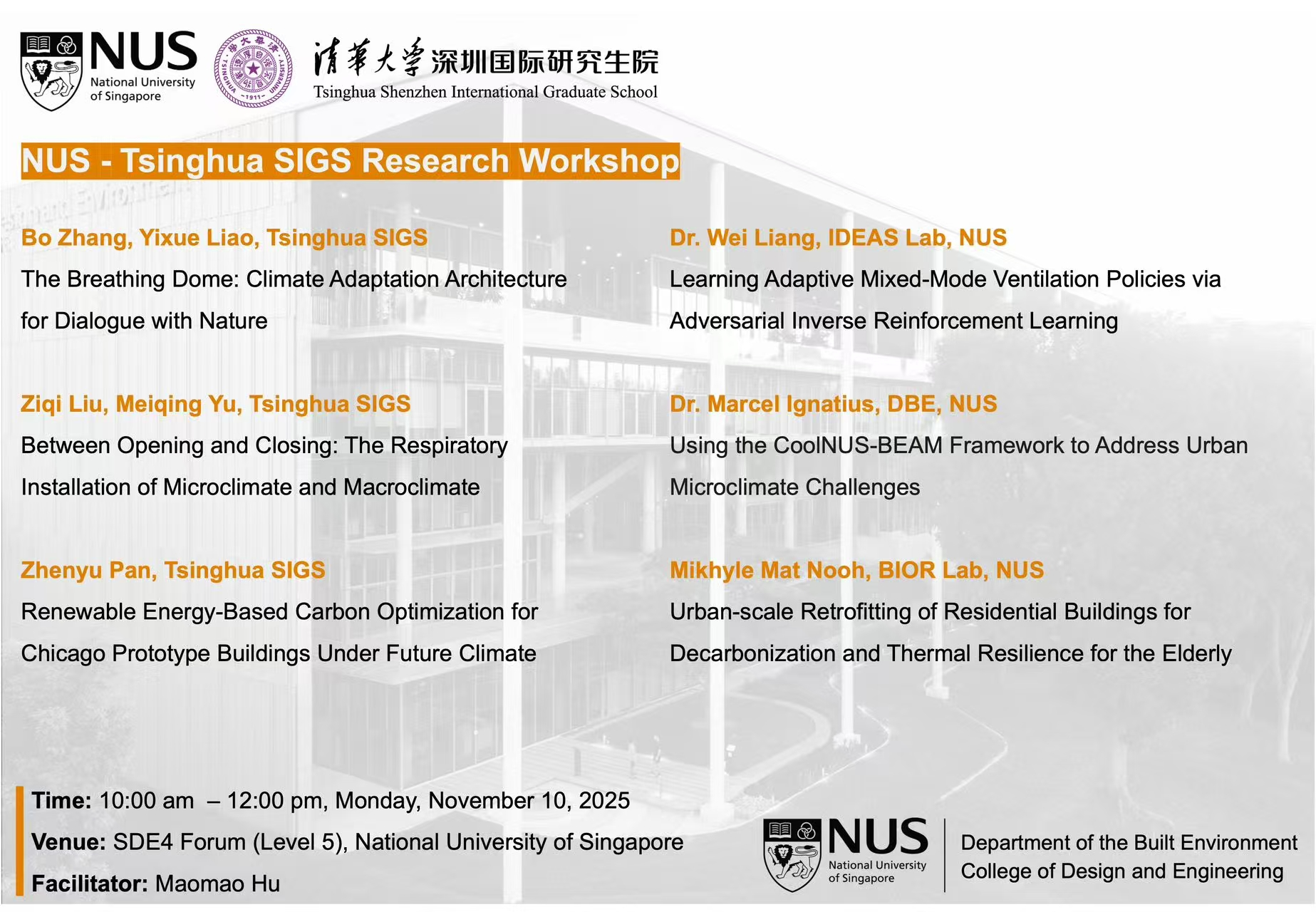 Pic. 1. Agenda of the Academic Sharing Session at NUS
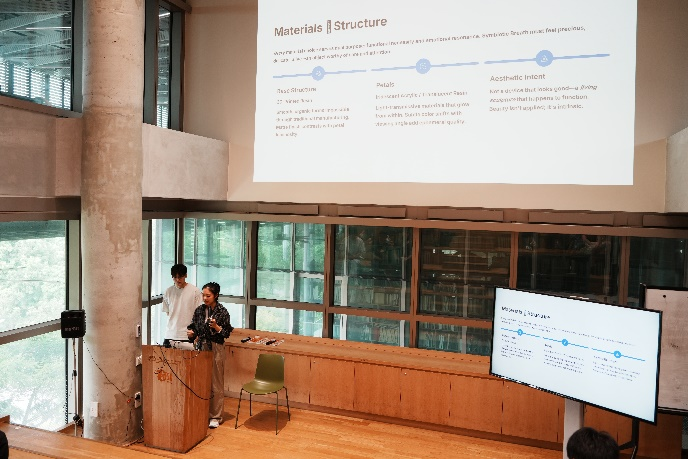 Pic. 2. Students of Tsinghua SIGS present the phased achievements of the design course
After the exchange, Professor Hu led the team on a tour of the SDE4 building at the NUS College of Design and Engineering. He explained how the building achieves its net-zero energy target through a combination of passive and active design strategies and technical measures, with on-site introductions to its specific approaches for climate adaptability and energy efficiency.
In the afternoon, guided by students from the College of Design and Engineering, the team toured the NUS campus. They experienced its multi-layered and uniquely styled architecture, which incorporates climate-adaptive design concepts reflective of the local context.
Academic Exchange with NUS Department of Architecture
On the morning of November 13rd, the team visited the NUS Department of Architecture (DOA) for a session on thermal environment optimization in architectural and urban design. The visit featured presentations from both sides: our team first shared our group work on climate-responsive design, followed by a discussion with DOA members. Then, Professor Yuan Chao and his team presented their research outcomes on climate-adaptive design for tropical high-density urban areas. This dialogue successfully broadened the students' perspective and stimulated their interest in (sub)tropical design strategies.
On the afternoon of November 13rd, the team held a discussion session with Professor Lam Khee Poh. Professor Lam, the former Dean of the NUS School of Design and Environment and a Tenured Chair Professor at Carnegie Mellon University, began by systematically introducing several typical green buildings in Singapore, sharing their practical experiences in energy conservation and climate-adaptive design. He then explored potential pathways for the future sustainable development of buildings and cities with the team, and the discussion extended to future career planning. During the session, Professor Lam also provided valuable feedback on the students' interim design projects, offering crucial insights for their subsequent design development.
Urban Field Investigation in Singapore
On November 8th and 11st, the team conducted field studies in Singapore's Marina Bay and Sentosa areas. The focus was on observing how these high-density urban centers employ various strategies to optimize the pedestrian-scale physical environment. These strategies included building massing, ground-level wind corridors, sheltered linkways, smart interactive installations, street furniture, and the design of small public spaces and water features. Through on-site observation, the team gained first-hand insight into urban-scale climate-adaptive design, gathering valuable empirical references for their subsequent responsive installation projects in the design studio.