
A novel approach for hourly weather downscaling for building performance simulation under future climate change
Pengyuan Shen *
2025
Building Simulation
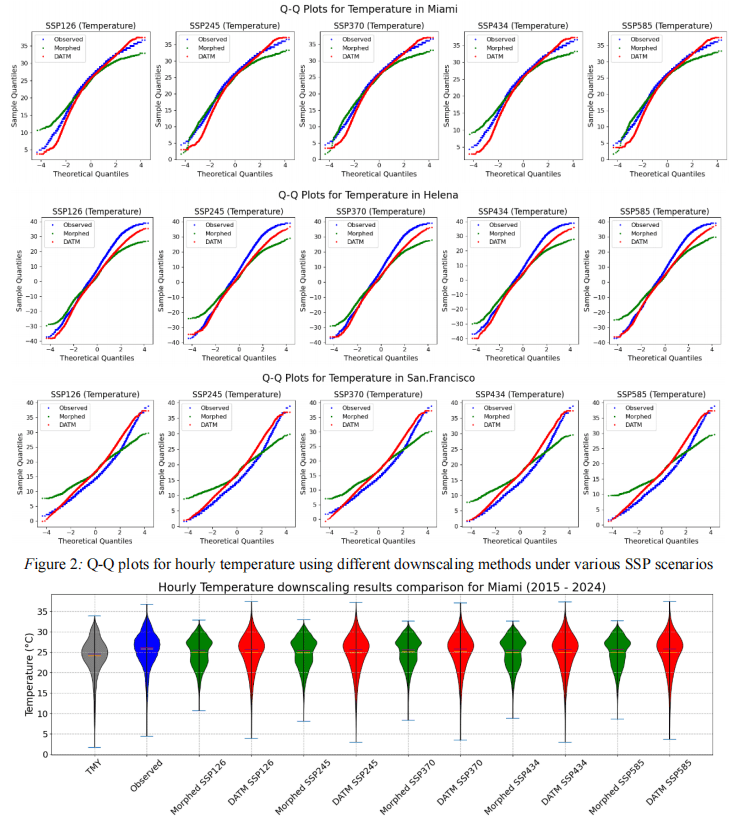
Figure 3: Distributions of hourly temperature downscaled by the two methods and comparison to TMY and observed data
Summary
This paper introduces Distribution Adjusted Temporal Mapping (DATM), a novel statistical downscaling method designed to generate hourly future weather data for building performance simulation (BPS). Validated against historical data from three U.S. cities, DATM outperforms the traditional "morphing" technique by better capturing temperature distributions and extreme events. This approach enhances the accuracy of building energy and resilience assessments under various future climate scenarios.
Abstract
Climate change presents a major threat to the built environment and therefore requires reliable future climate data for building performance simulation (BPS). The current approaches to downscaling future weather conditions are rarely developed for BPS studies and have challenges in representing climate change and its range, especially in the case of extreme conditions. This paper presents a new Distribution Adjusted Temporal Mapping (DATM) technique for scaling down the future hourly weather data from the monthly global climate model (GCM) data with Typical Meteorological Year (TMY) data being the baseline. The proposed method involves fitting probability distributions to TMY data for each climate variable, modifying these distributions according to the projected monthly changes from GCMs, and then mapping the future hourly weather data from the adjusted distributions. DATM is compared with the “morphing” technique for temperature downscaling in three representative cities – Miami, Helena, and San Francisco, and the hourly downscaled temperature results are validated against onsite measured hourly weather data of the three cities from 2015-2024. The outcomes reveal that DATM outperforms the morphing method in temperature downscaling in terms of reproducing climate variabilities and extreme events. DATM also shows good performance in capturing the changes in temperature variability and extremes that are essential for the overall building resilience analysis.
Introduction
Climate change presents significant challenges to the built environment, necessitating reliable methods to predict future building performance under changing climate conditions (Shen, 2024). Buildings account for approximately of global greenhouse gas emissions and of global energy consumption (IEA, 2023), making accurate predictions of their future performance crucial for adaptation and mitigation strategies (Shen, Li, et al., 2025). Building Performance Simulation (BPS) has emerged as a powerful tool for evaluating building behavior under future climate scenarios, but its effectiveness heavily depends on the quality of future weather data inputs (Wang & Zhai, 2016).
A key challenge in generating future weather data lies in the disparity between Global Climate Model (GCM) outputs and the requirements of building simulation. While GCMs provide valuable projections of future climate conditions, their spatial resolution (typically 100- ) and temporal resolution (monthly averages) are insufficient for detailed building analysis (Laflamme, Linder, & Pan, 2016). Building simulation requires hourly weather data that captures local climate characteristics, necessitating the development of effective downscaling techniques to bridge this gap (Herrera et al., 2017; Shen & Yang, 2020).
Two primary approaches have emerged for downscaling climate data: dynamical and statistical methods. While dynamic downscaling using regional climate models can provide detailed physical representations, it is
computationally intensive and resource demanding (Shen, Ji, Li, et al., 2025). Statistical downscaling methods, being more computationally efficient and flexible, have gained prominence in building performance-related studies (Nielsen & Kolarik, 2021). Among these, the morphing method introduced by Belcher et al. (Belcher, Hacker, & Powell, 2005) has become widely adopted, being used in approximately two-thirds of existing building performance studies (Nielsen & Kolarik, 2021). This study introduces a new Distribution Adjusted Temporal Mapping (DATM) method and compares its performance with the established morphing technique. We focus our analysis on three climatically diverse U.S. cities: Miami (representing a hot-humid climate), Helena (cold climate), and San Francisco (mild coastal climate). These cities were selected to evaluate the methods' effectiveness across varying climate conditions and to assess their capability in capturing both mean conditions and extreme events. The research aims to address several key questions:
- How effectively do these methods capture temperature distributions in different climate zones?
- What are the relative strengths and limitations of each method in representing extreme temperature events?
- How do the methods perform across different future climate scenarios?
By focusing on temperature, which is typically the most sensitive parameter in building performance simulation, this study provides valuable insights for practitioners and researchers in selecting appropriate downscaling methods for different climate contexts. The findings contribute to the broader goal of improving the accuracy and reliability of building performance predictions under future climate conditions. This comparative analysis is particularly timely given the increasing emphasis on building resilience and adaptation to climate change. As noted by recent study, considering climate change impacts in building and district energy system analysis is not just feasible but essential for effective long-term planning and design (Shen, Ji, & Zhong, 2025). The accuracy of downscaled weather data directly influences the reliability of building performance simulation and, consequently, the effectiveness of adaptation strategies.
Method
Overview of Downscaling Approaches
The study employs and compares two statistical downscaling methods: the newly proposed Distribution Adjusted Temporal Mapping (DATM) and the established morphing method. Both approaches aim to generate future hourly weather data from monthly GCM outputs, but they differ fundamentally in their methodological frameworks. Morphing Method
The morphing method, introduced by Belcher et al. transforms historical weather data through a combination of shifting and stretching operations to reflect projected climate changes. For temperature, it employs both a shift Proceedings of the 19th IBPSA Conference
Brisbane, Australia, Aug 24-27, 2025
(to adjust the mean) and a stretch (to modify the variability):
where is the future value, ??historical is the historical value, represents the change in mean value, and is the stretch factor representing changes in variability. This method preserves the underlying weather patterns while incorporating projected climate changes.
The proposed DATM Method
The DATM method takes a distribution-based approach to downscaling. It first determines the most appropriate probability distribution for temperature in the TMY data, then adjusts these distributions based on projected monthly changes from GCMs. For temperature, the method typically employs normal or skew-normal distributions (Brito & Duarte Silva, 2012). For wind speed, the distributions used are Lognormal, Weibull, and Rayleigh (Garcia, Torres, Prieto, & De Francisco, 1998; Pishgar-Komleh, Keyhani, & Sefeedpari, 2015). For relative humidity, it is Lognormal (Pierrehumbert, Brogniez, & Roca, 2007) and Beta (Yao, 1974). For solar radiation, it is Skew-normal, Normal, and Beta distribution (Youcef Ettoumi, Mefti, Adane, & Bouroubi, 2002). The process involves:
- Constructing empirical cumulative distribution functions (CDFs) for the TMY data:
where II() is the indicator function and N is the number of observations.
- Adjusting the distribution parameters to match future projections while preserving the statistical properties of the historical data.
- Mapping the quantiles of future model projections to the historical observed data to obtain downscaled values.
Validation and Comparison Methods
Quantile-Quantile (Q-Q) Plots
Q-Q plots serve as a visual tool for comparing the distributions of downscaled and historical temperature data. For ordered data , the Q-Q plot consists of points:
where is the inverse cumulative distribution function of the standard normal distribution, i is the rank of , and n is the sample size. These plots help assess how well each downscaling method preserves the statistical properties of temperature distributions, particularly at the extremes.
Kolmogorov-Smirnov Test
The two-sample Kolmogorov-Smirnov (K-S) test provides a quantitative measure of the similarity between downscaled and historical temperature distributions. The K-S test statistic D is defined as:
where and are the empirical cumulative distribution functions of the two samples being compared. Lower D values indicate better agreement between distributions.
Data and Study Areas
The analysis focuses on three cities selected to represent distinctly different climate zones across the United States. Miami, Florida represents a hot-humid climate (ASHRAE zone 1A), characterized by high temperatures and humidity year-round. Helena, Montana exemplifies a cold climate (ASHRAE zone 6B) with significant seasonal temperature variations and cold winters. San Francisco, California represents a mild coastal climate (ASHRAE zone 3C) with moderate temperatures and strong maritime influence.
For each city, we utilized three primary data sources. First, TMY data served as the historical baseline for both downscaling methods. Second, we obtained monthly outputs from the MRI-ESM2-0 Global Climate Model under five different Shared Socioeconomic Pathways (SSPs): SSP126, SSP245, SSP370, SSP434, and SSP585. Third, we collected historical weather data from 2015- 2024 for validation purposes. The MRI-ESM2-0 model

Miami

Helena

Best-fit distributions for weather variables
San Francisco
Figure 1: Best fit distributions for weather variables in the three cities based on TMY data
The analysis of TMY data reveals distinct distribution patterns for temperature across the three climatically diverse cities as shown in Figure 1. For temperature, all three cities demonstrate good alignment with normal or skew-normal distributions, though with notably different parameters reflecting their distinct climate characteristics. Miami exhibits a relatively narrow, right-skewed temperature distribution centered around , reflecting its consistently warm climate. Helena shows a broader, more symmetric distribution with a lower mean temperature around , indicative of its more variable continental climate with significant seasonal temperature swings. San Francisco displays a notably compact temperature distribution centered near , characteristic of its moderate coastal climate with limited temperature variation.
Analysis of Temperature Downscaling Performance
The performance of both downscaling methods can be evaluated through the comparative analysis of the Q-Q plots (as shown in Figure 2) and the violin plots (as shown
(Yukimoto et al., 2019) was selected for this study due to its demonstrated capability in simulating climate systems and its inclusion in the Coupled Model Intercomparison Project Phase 6 (CMIP6) (Eyring et al., 2016). The model has been extensively evaluated and has shown good results across different climate conditions. The five SSP scenarios used in this study represent different possible future pathways of greenhouse gas emissions and socioeconomic development. These range from sustainable development with strong climate change mitigation (SSP126) to fossil-fuel intensive development with very high emissions (SSP585). The validation analysis examines both methods' performance across these diverse climate zones and scenarios, with particular attention to their ability to capture extreme temperature events and maintain the statistical properties of the original temperature distributions. This comprehensive evaluation provides insights into each method's strengths and limitations in different climatic contexts, offering valuable guidance for practitioners in selecting appropriate downscaling methods for specific applications.
Results and Analysis
in Figure 3) across the three cities under different SSP scenarios. These visualizations reveal distinct patterns in how each method captures temperature characteristics in different climate zones.
In Miami, the Q-Q plots demonstrate that both methods perform well for mid-range temperatures but diverge significantly at the extremes. The DATM method better captures high-temperature extremes above across all SSP scenarios, while the morphing method tends to underestimate these extremes. This finding is reinforced by the violin plots, which show the DATM method maintaining a distribution shape more consistent with the observed data (blue violin) compared to the morphing method.
Helena's results illustrate the challenges of downscaling in a location with extreme temperature variations. The Q-Q plots reveal significant deviations at both temperature extremes (below and above ), though the DATM method generally tracks closer to the observed distribution line. The violin plots demonstrate temperature

distributions spanning from to , with the DATM method better preserving the characteristic bimodal distribution pattern observed in the historical
data, particularly evident in the broader spread at both temperature extremes.

Q-Q Plots for Temperature in Miami


Q-Q Plots for Temperature in Helena


Q-Q Plots for Temperature in San.Francisco


Figure 2: Q-Q plots for hourly temperature using different downscaling methods under various SSP scenarios

Hourly Temperature downscaling results comparison for Miami (2015 - 2024)

Hourly Temperature downscaling results comparison for Helena (2015 - 2024)

Hourly Temperature downscaling results comparison for San.Francisco (2015- 2024)
Figure 3: Distributions of hourly temperature downscaled by the two methods and comparison to TMY and observed data
San Francisco presents a unique case with its moderate coastal climate. The Q-Q plots show notable differences between methods particularly in the upper temperature range (above ), where the morphing method tends to overestimate extremes while the DATM method maintains better alignment with observed patterns. The violin plots confirm this pattern, showing more concentrated distributions in the DATM results that better match the observed data's relatively narrow temperature range of to .
Across all cities, the relative performance of both methods remains fairly consistent across SSP scenarios, though differences become more pronounced in higher emission scenarios (SSP585). The violin plots reveal that the morphing method consistently produces wider
temperature distributions than observed, while the DATM method generally maintains distributions more similar to the historical patterns. This consistency across scenarios suggests that the methods' relative strengths and limitations are more influenced by local climate characteristics than by the specific emission scenario being modeled.
Statistical Validation Using K-S Test
To quantitatively validate the performance of both downscaling methods, Kolmogorov-Smirnov (K-S) tests were performed to assess the similarity between downscaled and observed temperature distributions. Lower K-S test statistics indicate better agreement between distributions. The results are illustrated in.
Table 1: K-S test results for the proposed DATM method and morphing method in three cities
For Miami, the DATM method achieved better performance with an average K-S statistic of 0.106 compared to 0.115 for the morphing method. This improvement was consistent across all SSP scenarios, with the most notable difference in SSP370 where DATM's K-S statistic (0.094) was significantly lower than morphing's (0.102). Helena showed more pronounced differences between methods, with DATM's average K-S statistic of 0.145 outperforming morphing's 0.175. The difference was particularly evident in higher emission scenarios, suggesting DATM's superior ability to handle extreme temperature projections in continental climates. San Francisco demonstrated the largest performance gap, with DATM achieving an average K-S statistic of 0.271 compared to morphing's 0.332. This substantial difference indicates that DATM is particularly effective at capturing temperature distributions in moderate coastal climates where subtle variations can be significant. These statistical results further corroborate the visual observations from the distribution and Q-Q plots, providing quantitative evidence of DATM's superior performance across different climate zones.
Discussions
The comparative analysis of DATM and morphing methods across three climatically diverse cities reveals important insights about the strengths and limitations of each downscaling approach. Our findings indicate that while both methods can effectively downscale temperature data, their performance varies significantly based on local climate characteristics and the nature of temperature extremes being modeled.
The DATM method's superior performance in capturing temperature distributions can be attributed to its fundamental approach of adjusting probability distributions rather than applying linear transformations. This advantage is particularly evident in cities with complex temperature patterns, such as Helena's extreme seasonal variations or San Francisco's maritimeinfluenced climate. The method's ability to preserve the statistical properties of local temperature distributions while incorporating future climate signals makes it especially valuable for building performance simulations where accurate representation of temperature extremes is crucial. However, both methods face challenges in certain contexts. The morphing method, while computationally simpler, tends to overestimate temperature ranges and struggles with extreme events, particularly in cities with more variable climates. This limitation can become more pronounced in higher emission scenarios (SSP585), suggesting that the method's linear transformation approach may be less suitable for modeling more extreme climate change scenarios.
These findings have important implications for building performance simulation practice. The choice of downscaling method can significantly impact the accuracy of future weather predictions, particularly for extreme temperature events that are critical for HVAC system sizing and building resilience assessment. The DATM method's better performance in capturing these extremes suggests it may be more suitable for applications where accurate representation of extreme conditions is paramount.
Looking forward, these results suggest several areas for future research. Further validation across a broader range of climate zones and weather variables would be valuable, as would investigation of the methods' performance in capturing inter-variable relationships. Additionally, exploring how these methods perform in representing future extreme weather events and their implications for building resilience would be particularly relevant given increasing climate change concerns.
Conclusions
This study introduced and evaluated a new Distribution Adjusted Temporal Mapping (DATM) method for downscaling future temperature data, comparing its performance with the widely used morphing method across three climatically diverse U.S. cities. Through comprehensive statistical analysis and validation against historical data from 2015-2024, several key findings emerge.
First, the DATM method demonstrates superior performance in capturing temperature distributions across all three climate zones, with particularly strong advantages in representing extreme temperatures. The method's success is evidenced by lower K-S test statistics compared to the morphing method, with improvements in the three selected cities being made. Second, the effectiveness of both downscaling methods varies significantly with local climate characteristics. While DATM consistently outperforms the morphing method, its relative advantage is most pronounced in locations with complex temperature patterns, such as Helena's extreme seasonal variations and San Francisco's moderate coastal climate. This finding underscores the importance of considering local climate characteristics when selecting downscaling methods for building performance simulation. Both methods maintain relatively consistent performance across different SSP scenarios, though DATM shows better robustness in handling more extreme climate projections, particularly in SSP585. This suggests that DATM may be more suitable for long-term building resilience studies where accurate representation of potential extreme conditions is crucial.
These findings contribute to the advancement of building performance simulation by providing a more accurate
method for generating future weather data. The enhanced capability of DATM in capturing both mean conditions and extreme events makes it particularly valuable for applications involving building energy analysis and resilience assessment. Future research should focus on extending the validation to other climate variables and exploring the method's applicability in representing compound climate extremes.
References:
Belcher, S. E., Hacker, J. N., & Powell, D. S. (2005). Constructing design weather data for future climates. BUILDING SERV ENG RES TECHNOL, 26(1), 49-61. doi:10.1191/0143624405bt112oa
Brito, P., & Duarte Silva, A. P. (2012). Modelling interval data with Normal and Skew-Normal distributions. Journal of Applied Statistics, 39(1), 3-20.
Eyring, V., Bony, S., Meehl, G. A., Senior, C. A., Stevens, B., Stouffer, R. J., & Taylor, K. E. (2016). Overview of the Coupled Model Intercomparison Project Phase 6 (CMIP6) experimental design and organization. Geoscientific Model Development, 9(5), 1937- 1958.
Garcia, A., Torres, J., Prieto, E., & De Francisco, A. (1998). Fitting wind speed distributions: a case study. Solar Energy, 62(2), 139-144.
Herrera, M., Natarajan, S., Coley, D. A., Kershaw, T., Ramallo-González, A. P., Eames, M., . . . Wood, M. (2017). A review of current and future weather data for building simulation. Building Services Engineering Research and Technology, 38(5), 602-627. doi:10.1177/0143624417705937
IEA. (2023). Tracking Buildings. Retrieved from https://www.iea.org/energy-system/buildings:
Laflamme, E. M., Linder, E., & Pan, Y. (2016). Statistical downscaling of regional climate model output to achieve projections of precipitation extremes. Weather and Climate Extremes, 12, 15-23. doi:https://doi.org/10.1016/j.wace.2015.12.001
Nielsen, C. N., & Kolarik, J. (2021). Utilization of Climate Files Predicting Future Weather in Dynamic Building Performance Simulation – A review. Journal of Physics: Conference Series, 2069(1), 012070. doi:10.1088/1742- 6596/2069/1/012070
Pierrehumbert, R. T., Brogniez, H., & Roca, R. (2007). On the relative humidity of the atmosphere. The global circulation of the atmosphere, 143, 185.
Pishgar-Komleh, S., Keyhani, A., & Sefeedpari, P. (2015). Wind speed and power density analysis based on Weibull and Rayleigh distributions (a case study: Firouzkooh county of Iran). Renewable and Sustainable Energy Reviews, 42, 313-322.
Proceedings of the 19th IBPSA Conference
Brisbane, Australia, Aug 24-27, 2025
Shen, P. (2024). Building retrofit optimization considering future climate and decision-making under various mindsets. Journal of Building Engineering, 96, 110422. doi:https://doi.org/10.1016/j.jobe.2024.110422
Shen, P., Ji, Y., Li, Y., Wang, M., Cui, X., & Tong, H. (2025). Combined impact of climate change and heat island on building energy use in three megacities in China. Energy and Buildings, 115386. doi:https://doi.org/10.1016/j.enbuild.2025.1153 86
Shen, P., Ji, Y., & Zhong, M. (2025). Performance of district energy system under changing climate: A case study of Shenzhen. Applied Energy, 379, 124986. doi:https://doi.org/10.1016/j.apenergy.2024.124 986
Shen, P., Li, Y., Gao, X., Zheng, Y., Huang, P., Lu, A., . . . Chen, S. (2025). Recent progress in building energy retrofit analysis under changing future climate: A review. Applied Energy, 383, 125441. doi:https://doi.org/10.1016/j.apenergy.2025.125 441
Shen, P., & Yang, B. (2020). Projecting Texas energy use for residential sector under future climate and urbanization scenarios: A bottom-up method based on twenty-year regional energy use data. Energy, 193, 116694. doi:https://doi.org/10.1016/j.energy.2019.11669 4
Wang, H., & Zhai, Z. (2016). Advances in building simulation and computational techniques: A review between 1987 and 2014. Energy and Buildings, 128, 319-335. doi:https://doi.org/10.1016/j.enbuild.2016.06.08 0
Yao, A. Y. (1974). A statistical model for the surface relative humidity. Journal of Applied Meteorology and Climatology, 13(1), 17-21.
Youcef Ettoumi, F., Mefti, A., Adane, A., & Bouroubi, M. Y. (2002). Statistical analysis of solar measurements in Algeria using beta distributions. Renewable Energy, 26(1), 47-67. doi:https://doi.org/10.1016/S0960- 1481(01)00100-8
Yukimoto, S., Kawai, H., Koshiro, T., Oshima, N., Yoshida, K., Urakawa, S., . . . Hosaka, M. (2019). The Meteorological Research Institute Earth System Model version 2.0, MRI-ESM2. 0: Description and basic evaluation of the physical component. Journal of the Meteorological Society of Japan. Ser. II, 97(5), 931-965.
Figure 3: Distributions of hourly temperature downscaled by the two methods and comparison to TMY and observed data
Publication Details
Journal
Building Simulation
Publication Year
2025
Authors
Pengyuan Shen *
Categories
Building performance assessment under climate change