
Passive design strategies for curtain wall system in subtropical office buildings in China considering multi-sensory comfort
Lei Yub, Caifang Linb, Wei Gub, Xing Zheng, Yi Zhang, Pengyuan Shen
2026
Energy and Built Environment
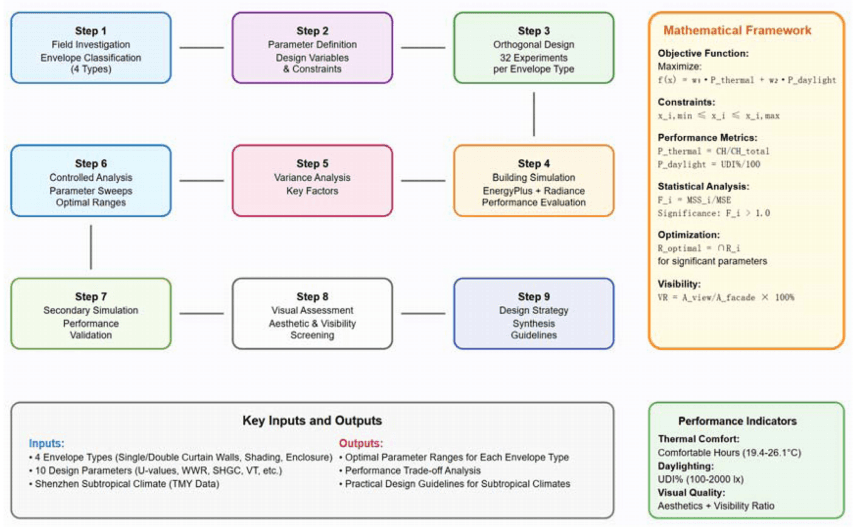
Fig. 1. Research framework.
Summary
This study investigates passive design strategies for curtain wall systems in subtropical office buildings in China, aiming to synergize energy efficiency and multi-sensory comfort. It addresses the trade-offs between cooling loads, daylighting, and visual quality in high-rise glazed structures. By optimizing envelope parameters, the research provides design guidelines that enhance indoor environmental quality while minimizing energy consumption, offering a holistic approach to sustainable building skin design in hot-humid climates.
Abstract
In subtropical urban environments where glass building curtain walls predominate in the high-rise office construction, the building envelope plays an important role in determining energy use and comfort level within the building. This work formulates passive design concepts to the high rises office building in the subtropical China through a systematic evaluation of four common envelope types, namely, single-layer curtain walls, single-layer curtain walls with shading, double-layer curtain walls, and continuous shading with enclosure structures. Based on representative subtropical climate condition as a typical example of the subtropics in China, a parametric analysis is conducted using various comfort performance criteria including thermal comfort hours, useful daylight illuminance (UDI), and visual quality. EnergyPlus and Radiance performance simulations identified the optimum parameter spaces in each envelope type: for single-layer curtain walls, 565–591 comfortable hours could be achieved annually with glass U-values ranging from $1 . 7 { - } 3 . 2 \ \mathrm { W / m ^ { 2 } K }$ of glass U-value and window-to-wall ratios of 0.40–0.60; the single-layer curtain walls with shading had the best performance overall, providing 599–601 comfortable hours. After eliminating designs that fail to achieve adequate visual performance with average interior visibility ratio $> 4 0 ~ \%$ , this work provides evidence-based design guidelines for curtain wall systems that maintain a balance between thermal comfort, quality of daylighting and aesthetics. The evidence-based design measures described in this paper are useful to architects and engineers intending to optimize the building envelope design within the subtropical climate, addressing the gap of theoretical knowledge and practical application to sustainable high-rise construction.
1. Introduction
Land use change and increasingly dense population distribution triggered by urbanization have resulted in complex interactions between the local climate change in cities and building energy consumption [1]. The resulting high urbanization rate in China has led to the development of many high-rise office buildings with high energy consumption [2]. Examples of representative subtropical areas in China include Hong Kong, Shenzhen, and Guangzhou, where such structures are concentrated [3]. Therefore, decreasing the energy demand of such buildings may help to reduce overall energy consumption and carbon emissions in China and thereby limit the adverse effects on the environment.
Building envelope is a key factor in determining building energy use [4]. However, high-rise office buildings that tend to use large-area pure glass curtain walls in subtropical regions are not necessarily
well-adapted to the climate. Such a mismatch may have unfavorable consequences such as overheating [5], glare [6], and energy use [7]. Researchers have discussed the building envelope in relation to modernism, which provide insight into how contemporary structures are becoming fascinated with transparency that has been promoted by modernism and its interaction with visual culture, which should be evaluated in depth [8]. Therefore, other researchers have shifted their attention to developing building envelopes in accordance with biomimicry principles and climate-adaptive measures in the face of climate change context [9]. Metaphor as bio-skin, building envelopes are categorized under architectural biomimicry corresponding climate change [10,11]. Despite these research endeavors, the continued widespread use of pure glass curtain walls indicates that there is a discrepancy between theory and practice in building envelope design in terms of improved interior comfort and energy savings.
This predicament is especially pronounced in the subtropical highrise office buildings where various conflicting and sometimes competing goals must be achieved through the envelope design: low solar heat gain and high daylight, exterior views and glare control, architectural aesthetics and energy optimization. This complexity demands a thor-
Nomenclature
Performance metrics
Design parameters
Statistical analysis
Building geometry
Other terms
ough investigation of the performance of various types of envelopes in subtropical environments, which has not been adequately conducted with respect to individual performance aspects under subtropical climate conditions. Therefore, investigating the reasons behind this gap and developing optimal solutions are critical for building envelope design to reflect the feasible applicability in the subtropics.
This research seeks to narrow the gap between theory and practice by providing specific guidelines for architects on how to design buildings that address various performance challenges while not compromising architecture quality in design. The main contributions of the study are: (1) an extensive performance review of four representative major envelope types in subtropical climate, (2) a determination of ideal parameter range of the key design variables through systematic examination, (3) assessment of energy performance, thermal comfort, and visual quality
trade-offs and (4) formulation of practical design guidelines that take into account various performance factors in subtropical high-rise office buildings. The contributions made extend theoretical concepts of the behavior of envelopes in subtropical climates as well as practical knowledge on the design of sustainable high-rise buildings in line with the current demands of climatologically active architecture in the subtropical cities of the world, which are growing at a fast pace.
2. Literature review
There has been a considerable paradigm shift in the conceptualization of building envelopes, which have evolved into complex and multifunctional building skins, which is a building enclosure. In his pioneering work on primitive architecture, Semper had recognized enclosure as one of the four elements contained therein in The Four Elements of Architecture (1851) [12]. Later research extended the knowledge about building envelopes as being a dynamic, multi-layered system. Tombazis advocated for multi-layered building skin systems where successive layers serve specific functional purposes like thermal insulation, moisture management and weather barrier functionalities [13]. Radwan elaborated on this idea by stating that the building skin could be a multifunctional shell that is actively engaged in controlling the environmental variables such as sunlight, air, humidity, sound and heat exchange [14]. Such contributions led to the modern concept of building envelopes as complex environmental control systems that mediate between interior and exterior environments.
Building envelope performance can be evaluated through analytical methods, experimental measurement, or computational simulation. While analytical methods provide fundamental insights [15,16] and experimental approaches offer real-world validation [17,18], computational simulation using validated tools like EnergyPlus [19,20] and Radiance [21] enables systematic parametric exploration of multiple design alternatives under controlled conditions. This capability is essential for comparative optimization studies requiring consistent boundary conditions across numerous design configurations. The reliability and accuracy of these simulation platforms have been extensively validated against measured data, establishing them as standard tools for evidence-based building design [6,19–22]. The capacity of simulation techniques to systematically test numerous design alternatives under identical boundary conditions makes them particularly suitable for the parametric optimization methodology employed in this research, enabling comparative evaluation of design configurations across various building envelope types.
Passive design is an essential environmental control strategy that is frequently adopted in vernacular architecture in accordance with climatic circumstances [20], which improves adaptability to environmental variations and environmental control. Allam demonstrated that envelopes developed using passive design principles can achieve significant energy savings compared to conventional methods [23]. Nevertheless, passive design measures have practical barriers that hinder their usage on a large scale in the professional sector. Tian’s studies uncovered the most severe barriers to passive design application, including prolonged calculations, a lack of a unified design process [24]. These difficulties hinder architects from achieving optimal building performance through passive approaches in the design development stage of development where decisions defining the basis of the design are made. Passive design analysis tends to be complex and therefore demands specialized skills and computing power, which are not easily found in typical architectural practice, thus creating a gap between research and practical knowledge. A theoretical basis for implementing passive design in sustainable architecture was established by the Guiding Principles of Sustainable Design, published in the United States in 1994 [25]. Passive design was introduced as an integral part of sustainable architectural practice in which the use of natural light and solar energy use were noted as the key factors in energy savings and nature sustenance. Nevertheless,
bridging the gap between principle and practice has been challenging, especially for complex building types and severe climatic environments.
Passive design implementation presents unique opportunities under subtropical climatic conditions. During transitional seasons in the subtropics, buildings can attain thermal comfort through natural ventilation, and fulfillment of lighting needs with natural daylighting, thus reducing reliance on mechanical systems [26]. This indicates that passive design strategies should not be limited to energy consumption considerations in a building but should also aim to enhance building performance through natural environmental conditions. This was demonstrated by Srisamranrungruang, who showed that the application of passive design techniques specifically designed to provide building envelope features in building structure during transitional seasons in the subtropics provides an in-depth examination of the envelope’s capacity to respond to climatic conditions [27]. This evaluation methodology assesses thermal and lighting performance based on the conditions of natural ventilation and lighting and provides a more comprehensive perspective on envelope effectiveness than energy-oriented indicators alone. Such assessment techniques are needed to develop design strategies that simultaneously satisfy multiple performance requirements. The persistent gap between passive design theory and professional practice is particularly evident in subtropical high-rise office buildings, where pure glass curtain walls continue to dominate despite documented issues with overheating [28], glare [6], and excessive energy consumption [7]. This prevalence indicates a significant disconnect between research findings and design implementation. The challenge stems partly from the complexity of passive design optimization, which demands specialized skills and computational resources not readily available in conventional architectural practice, creating a barrier between research insights and their practical application [24]. Furthermore, existing passive design research has predominantly focused on individual envelope types or single performance aspects, providing limited comparative frameworks for designers who are evaluating alternative envelope strategies. The lack of systematic comparative analysis across multiple envelope types under consistent subtropical climate conditions leaves practitioners without evidence-based guidance for selecting and optimizing curtain wall systems that balance thermal comfort, daylighting quality, visual aesthetics, and construction feasibility.
For effective multi-factor design optimization, systematic identification of key influencing factors is required [29]. The orthogonal experimental method offers a systematic approach to multi-factor analysis through strategic sampling of adequate combinations of comprehensive experimental matrices based orthogonality principles. Using this methodology, full factorial results can be approximately through strategic selection of experimental cases to adhere to the statistical validity. This methodology enables representation of full factorial design space through carefully planned limitation of simulation scenarios, significantly reducing computational requirements while preserving analytical rigor. Gong’s application of orthogonal methodology demonstrated its usefulness in optimizing building designs by simulating values and combinations of seven passive design elements in residential buildings [30]. Through variances analysis, this study established the relative importance of individual design elements, and identify an optimal combinations of passive design elements for residential buildings in different climatic regions of China. This study demonstrated that orthogonal test design is a feasible method for building envelope optimization in the Chinese environment. After identifying important design parameters through orthogonal analysis, correlation analysis can be performed between each of the design components and evaluation indexes enabling fine-tuning of envelope designs can be made. Krstic-Furundzic and Kosić used EnergyPlus to optimize the location and size of the shading devices of the office buildings and then identified proper shading systems depending on the climatic conditions in that particular locality by comparing the simulation results systematically [31]. This demonstrates the potential of combining orthogonal experimental design with correlation analysis to develop climate-specific guidelines related to design.
Simulation-based design research raises significant methodological concerns regarding validation. Previous studies, such as Cong and Chan’s development of facade design guidelines using Radiance simulation [32] and the shading optimization of an office building by the use of EnergyPlus by Krstic-Furundzic and Kosić [31] lacked validation through actual field measurements. The maturity and documented accuracy of both Radiance and EnergyPlus simulation platforms, supported by numerous independent validation studies, provide a foundation for this approach. Studies aimed at developing design guidelines can reasonably emphasize relative comparison of simulation results over absolute accuracy verification [29]. When the main task is comparative evaluation of design options rather than absolute performance prediction, relative accuracy is more important than absolute accuracy. This methodological approach is suitable for studies focused on developing design guidelines and strategies other than accurate performance prediction. The present study adopts this methodology, comparing relative simulation validity rather than field measurement validation in the design pattern examination phase. This aligns with the research objective of developing design strategies and guidelines as it happened in other research studies in terms of design pattern analysis [30]. The focus is on providing beneficial insights for practitioners rather than precisely predicting how a particular installation will perform.
Balancing thermal comfort, daylighting quality, and visual aesthetics presents a fundamental challenge in building envelope design, as these objectives often impose conflicting requirements on design parameters. Mangkuto et al. investigated the balance between daylight availability and energy efficiency in tropical office buildings, finding that window configurations optimized for daylighting often increase cooling loads substantially [33]. Li et al. developed multi-objective optimization frameworks addressing energy efficiency, daylighting, view quality, and thermal comfort simultaneously, highlighting the complexity of achieving balanced performance across multiple criteria [34]. However, aesthetic quality and interior visibility, which significantly influence design decisions in professional practice, are rarely integrated into quantitative envelope optimization frameworks. Limited research has addressed the aesthetic aspects of high-rise building envelopes together with quantitative building performance optimization [35], with few studies such as Tabadkani et al.’s addressing this topic in their review without conducting specific empirical research [36]. This gap between performancefocused optimization research and practice-oriented design guidance that incorporates visual quality considerations motivates the comprehensive multi-criteria approach adopted in this study.
Although substantial research literature exists building envelope design, three major gaps restrict its application to subtropical high-rise office buildings. First, most previous studies focus on a single envelope type or performance aspect in isolation without providing a comparison across various envelopes and performance criteria. Second, research emphasis on temperate climate may leave subtropical context underrepresented despite their specific environmental challenges such as high humidity, intense solar radiation, and extended cooling seasons. Third, while theoretical passive design frameworks exist, practical areas guidance on design parameter ranges for professional application is lacking. This research addresses these gaps through systematic comparative analysis of four principal envelope types under subtropical conditions, evaluating 128 design configurations across multi-sensory comfort criteria including thermal comfort, daylighting quality, visual comfort, and aesthetic appeal. Unlike previous studies that optimize individual performance aspects or neglect aesthetic considerations, this research integrates quantitative performance simulation with qualitative visual assessment, systematically eliminating configurations with poor facade aesthetics or inadequate interior visibility from the final design recommendations. This multi-criteria framework addresses the practical reality that architects must balance measurable environmental performance with visual quality considerations that influence occupant satisfaction and design acceptance. Using Shenzhen’s climate as a representative subtropical case, the study derives climate-specific design

Fig. 1. Research framework.
guidelines with optimal parameter ranges for each envelope type. The multi-criteria evaluation framework provides comprehensive consideration of performance trade-offs, bridging the divide between theoretical understanding and practical implementation for subtropical high-rise office buildings. By establishing evidence-based parameter ranges derived from systematic parametric analysis, this research provides designers with actionable guidance that has been lacking in previous literature, directly addressing the theory-practice gap that perpetuates suboptimal envelope design in subtropical high-rise construction.
To clarify the scope of this study, this work focuses specifically on vertical façade systems rather than the complete building envelope. While the term "building envelope" technically encompasses all building enclosure surfaces (walls, roof, and foundation), this research examines only the exterior wall assemblies, which dominate environmental performance in high-rise office buildings. The terms "building envelope," "façade system," and "curtain wall" are used throughout to refer specifically to these vertical wall components, with curtain walls representing the non-load-bearing, glazing-dominated subset.
3. Methodology
This research employs a systematic parametric simulation and analysis approach using orthogonal experimental design to evaluate curtain wall performance for subtropical high-rise office buildings. The methodology integrates building performance simulation with façade visual analysis to develop comprehensive design strategies that balance thermal comfort, daylighting quality, and visual aesthetics. The research framework is formulated to enable quantitative optimization of multiple design objectives simultaneously. As the primary objective of this work is to comparative evaluate 128 design alternatives and establish relative performance hierarchies and optimal parameter ranges, the relative accuracy of validated simulation tools like EnergyPlus and Radi-
ance is paramount, consistent with established methodologies for design pattern analysis. Absolute performance prediction, which would necessitate field validation, is beyond the scope of this strategic design exploration.
3.1. Research framework and building model
This research employs a systematic nine-step parametric analysis framework to optimize curtain wall performance for subtropical highrise office buildings, as illustrated in Fig. 1. The methodology integrates orthogonal test design with building performance simulation and visual assessment to develop comprehensive design strategies that balance thermal comfort, daylighting quality, and aesthetic considerations.
The research workflow proceeds through nine interconnected steps as depicted in Fig. 1: (1) field investigation and envelope classification to identify prevalent façade types in subtropical regions, (2) establishment of design parameter ranges based on building standards and existing research, (3) orthogonal test design to systematically explore the parameter space with minimal computational cost, (4) building performance simulation using EnergyPlus and Radiance to evaluate thermal and daylighting performance, (5) variance analysis through ANOVA to identify statistically significant design parameters, (6) controlled variable analysis using optimal combinations to characterize individual parameter influences, (7) secondary simulation to validate performance relationships and determine optimal parameter ranges, (8) visual assessment to eliminate designs with poor aesthetic quality or inadequate interior visibility, and (9) synthesis of passive design strategies that achieve superior environmental and aesthetic performance.
The investigation centers on a standardized office unit measuring in length, in width, and in height, representing typical configurations in subtropical high-rise buildings as shown in Fig. 2. This standardized model enables consistent comparative analysis across


a)Single layer curtain wal

c)Single-layer curtain wall with shading
e)Indoor space


b)Envelope with continuous shading
d)Double-layer curtain wall

f)Space height
Fig. 2. Envelope configurations and indoor space evaluated in this research.
different envelope types while maintaining relevance to actual building practice. The office unit dimensions align with common planning modules in Chinese high-rise construction, ensuring that the research findings are applicable to real-world design scenarios. The research framework is mathematically formulated to enable quantitative optimization of multiple design objectives simultaneously. The general multiobjective optimization goal can be expressed in Eqs. (1) and (2):
where represents design variables (WWR, U-values, shading coefficients, etc.), and are normalized performance functions for thermal comfort and daylighting respectively, and , are weighting factors. To address the challenge of comparing fundamentally different performance criteria (thermal comfort measured in comfortable hours versus daylighting measured in UDI percentage), both metrics were normalized to a 0–1 scale before aggregation. The normalization was performed using min-max scaling across all design configurations within each envelope type, where the normalized value for any metric equals (actual value - minimum value) / (maximum value - minimum value). This scheme ensures that both thermal and daylighting performance contribute equally to the composite Performance Index regardless of their original units or scales.
The above quantitative optimization addresses thermal comfort and daylighting performance, while aesthetic quality is evaluated through a subsequent screening stage using questionnaire as used previously in Yi’s study [35]. Facade visual quality was assessed through a questionnaire survey involving 20 postgraduate students majoring in architecture, who rated each configuration for aesthetic acceptability. This twostage approach reflects professional design practice where aesthetic acceptability serves as a design constraint rather than a continuously optimized variable. Configurations achieving superior environmental performance but rated as aesthetically poor or exhibiting inadequate interior visibility are systematically eliminated from final recommendations, as detailed in Section 3.7.

Fig. 3. Proportion of envelope types of high-rise office buildings in Shenzhen and Guangzhou.
3.2. Building envelope classification and characterization
Field investigation of high-rise office buildings in Guangzhou and Shenzhen formed the basis for envelope classification in this work. Through keyword searches on architectural databases and direct field surveys, over ninety subtropical high-rise office buildings were analyzed, yielding 71 cases with envelope structures meeting the study criteria (41 in Shenzhen, 30 in Guangzhou). This analysis revealed four distinct envelope categories: single-layer curtain walls of cases), single-layer curtain walls with shading , double-layer curtain walls , and continuous shading with enclosure structures , as illustrated in Fig. 3.
The prevalence of single-layer curtain walls reflects their construction efficiency and relatively lower costs compared to alternative systems. Curtain walls incorporating various materials and shading configurations enable diverse façade effects while addressing solar control requirements. The limited adoption of double-skin curtain walls likely results from higher construction costs and potential overheating risks in subtropical climates when improperly designed. Table 1 presents representative examples of each envelope category, demonstrating the range of design approaches within each classification. The classification was based on a multitude of factors encompassing design, materials, and con-
Table 1 Subtropical high-rise public curtain wall prototypes.
struction methodologies. Building construction and façade appearance provides a basis for classifying buildings employing curtain walls. Based on whether buildings use shading devices and the number of layers in curtain walls, they can be categorized into three distinct types: singlelayer curtain walls, single-layer curtain wall with shadings, and doublelayer curtain walls. Previous studies comparing the energy-saving performance of single-layer curtain walls with shadings to those without shading have shown that these are typically regarded as distinct design patterns [37].
3.3. Design parameters and material specifications
Design variables were systematically identified for each envelope type based on their influence on thermal, visual, and construction performance. The parameter space can be mathematically represented as Eq. (3):
where the common parameters for all envelope types are
- : visible light transmittance [-]
- : window-to-wall ratio [-]
- : window operable area ratio
In this work, glazing systems were modeled using the WindowMaterial:SimpleGlazingSystem object in EnergyPlus, characterized by Ufactor, SHGC, and VLT. This approach represents established practice in comparative envelope optimization research [27,29,38,39] and is appropriate for parametric studies focused on identifying relative performance hierarchies and optimal parameter ranges rather than absolute performance prediction. Research on window thermal performance has demonstrated that center-of-glass properties (U-factor, SHGC) dominate overall window performance in high window-to-wall ratio applications typical of curtain wall systems [40], justifying the focus on glazing parameter optimization.
Additional type-specific parameters include
: : external shading coefficient [-] (for all types except single-layer curtain walls)
- : cavity depth [mm] (for double-layer curtain walls only)
- : ventilation opening height [mm] (for double-layer curtain walls only)
The design space constraints are defined as detailed in Table 2. These ranges encompass the spectrum of materials and configurations com-
Table 2 Design elements for different high-rise building façades.
monly available in subtropical construction practice, ensuring realistic optimization within practical implementation boundaries.
The parameter ranges are established through analysis of applicable building standards and existing research [41–43], which are as follows:
3.4. Performance evaluation metrics
Building performance evaluation employs two primary metrics aligned with passive design principles under natural conditioning. The thermal comfort performance is quantified through comfortable hours (CH), while daylighting performance is assessed using Useful Daylight Illuminance percentage (UDI %).
Comfortable hours represent periods when indoor temperatures fall within acceptable ranges without mechanical conditioning. Based on research specific to subtropical public buildings under natural ventilation, the comfort temperature range for Guangzhou was established as to [44]. The thermal performance function is defined in Eq. (4) as:
where
: for all occupied hours where
- (total occupied hours during simulation period) out of 3480 h (total simulation period)
- indoor air temperature at hour i
Useful Daylight Illuminance (UDI) percentage quantifies daylighting performance throughout the year [45]. The UDI is calculated as Eq. (5):
where
: number of hours when
- total daylight hours during simulation period
illuminance on the working plane at height
The working plane illuminance is evaluated using a grid system, with the average illuminance calculated as for n grid points shown in Eq. (6):
The simulation period corresponds to transitional seasons in Shenzhen’s typical meteorological year (TMY), specifically February 6 to April 20 and November 3 to January 12, totaling 145 days (3480 h). Thermal comfort and daylighting performance were evaluated only during occupied hours (weekdays 8:00–18:00), yielding 1040 occupied hours for assessment.
Natural ventilation operation follows the control equation:
where is the outdoor air temperature.
Natural ventilation was modeled using the ZoneVentilation:WindandStackOpenArea module in EnergyPlus, which calculates ventilation rates dynamically based on wind-driven and buoyancydriven airflow through operable window openings. Key input parameters include: operable window area determined by the window openable area ratio of total window area as specified in the parametric design variables), opening effectiveness coefficient of 0.6 for sliding windows typical of curtain wall systems, and discharge coefficient of 0.65 for combined wind and stack effect calculations. This approach calculates hourly ventilation rates as a function of wind speed, wind direction, indoor-outdoor temperature difference, and opening geometry.
Daylighting performance was evaluated using the Radiance lighting simulation engine (version 5.3) integrated with EnergyPlus through the EnergyPlus-Radiance coupling workflow. The integration employs a three-pass simulation approach: (1) EnergyPlus generates hourly sky conditions and building geometry, (2) Radiance performs ray-tracing calculations for each daylight hour, and (3) results are fed back to EnergyPlus for thermal load calculations.
The Radiance simulation parameters were configured as follows:
• Ambient bounces: 5 (-ab 5) for accurate multi-surface reflections
Ambient divisions: 1000 (-ad 1000) for high-quality indirect illuminance calculation
• Ambient super-samples: 20 (-as 20)
Table 3 Operational schedules for building performance simulation.
• Ambient resolution: 300 (-ar 300)
• Limit reflection: 7 (-lr 7) to track deep light paths
Material properties were assigned based on measured spectral reflectance values: interior walls (reflectance 0.70), ceiling (reflectance 0.80), floor (reflectance 0.20), and exterior ground surfaces (reflectance 0.15). Glazing optical properties including transmittance, front and back reflectance were derived from the International Glazing Database (IGDB) for each glass specification in the design parameter matrix.
Illuminance calculations employed a regular grid of 25 virtual sensors positioned on the working plane at height above the finished floor. The sensor array was configured as a grid with 2-meter spacing in both x and y directions, covering the primary work zone from 2 m to depth from the façade and centered laterally within the width. This configuration provides spatial resolution adequate to capture illuminance gradients while maintaining computational efficiency.
Each sensor calculated horizontal illuminance values (Ev) at hourly intervals throughout the simulation period. The UDI metric was computed by evaluating the fraction of occupied hours (8:00–18:00 on weekdays) when illuminance at each sensor point satisfied the useful range criterion (100–2000 lux). The overall UDI percentage reported for each design configuration represents the spatial average across all 25 sensor points, where n represents the total number of sensor points ). This averaging approach ensures that the reported UDI values reflect the overall spatial daylighting quality rather than being biased by extreme values at specific locations.
Since the study focuses on passive design performance during transitional seasons when natural ventilation is available, the HVAC system was disabled during the simulation period of February 6-April 20 and November 3-January 12. The comfortable hours metric therefore represents periods achievable through passive means alone, without mechanical conditioning. Operational schedules were defined according to typical office building occupancy patterns in China (GB50189–2015). These schedules shown in Table 3 ensure that performance metrics are evaluated under realistic occupancy and internal gain conditions representative of actual office building operations in subtropical China.
3.5. Orthogonal test design
Orthogonal test design enables systematic evaluation of multiple factors across their value ranges while minimizing the number of required simulations. For k factors each at m levels, a full factorial design would require simulation scenarios. The orthogonal design reduces this to n simulation scenarios where while maintaining statistical validity.
Each factor was divided into four levels ) within established parameter ranges, with separate orthogonal test conducted for each envelope type. For the seven common parameters, this yields orthogonal arrays, requiring only 16 simulation scenarios instead of full factorial combinations. Additional simulation scenarios account for type-specific parameters, resulting in 32 total simulation
scenarios per envelope type. The orthogonal array ensures balanced representation across factor levels, with the design matrix satisfying the requirement shown in Eq. (8):
where is the level of factor i in scenario j, is the Kronecker delta, and λ ensures orthogonality.
To enable comparative analysis across envelope types, the two primary environmental performance evaluation indicators were normalized and combined. The composite performance index is calculated as:
where
The normalized scores range from 0 to 1, with higher Performance Index (PI) values indicating superior combined thermal and lighting environments. The equal weighting of thermal comfort and daylighting performance ) reflects established multi-objective optimization practice in building performance research. The weightedsum method is a fundamental technique for combining multiple objectives into a single performance metric, as documented in comprehensive reviews of computational optimization methods applied to sustainable building design [34,46]. Balanced weighting factors based on normalized sub-objectives represent a balanced decision-making approach adopted in previous building envelope optimization research to achieve unbiased evaluation across multiple performance dimensions [47]. This approach is particularly appropriate for developing general design guidelines applicable to diverse project contexts, where different stakeholders may prioritize thermal or visual performance differently.
To validate the robustness of this equal weighting approach, we have also conducted sensitivity analysis examining how performance rankings and optimal parameter ranges respond to alternative weighting schemes. Fig. 4 documents the results under three weighting scenarios: equal weighting ), daylighting emphasis , ), and thermal emphasis , ). The analysis reveals that performance hierarchies can remain relatively stable across all envelope types, with single-layer curtain walls with shading consistently achieving good Performance Index values of 0.68–0.75 regardless of weighting scheme. Optimal parameter ranges show minimal variation, with WWR ranges remaining unchanged (0.4–0.6 for single-layer systems) and external shading coefficient ranges shifting by units, which is of parameter ranges. This stability indicates that our recommended balanced weighting factors can provide reliable guidance despite changes in project-specific priorities, as configurations achieving balanced performance through effective solar control and natural

Fig. 4. Sensitivity analysis of performance rankings and optimal parameter ranges under alternative weighting schemes.
ventilation optimization simultaneously benefit both thermal comfort and daylighting quality.
3.6. Controlled variable analysis and optimization
Following identification of high-sensitivity design elements, detailed performance relationships were established through controlled variable analysis. This process involves systematic parametric sweeps of significant variables while maintaining other parameters at their optimal values identified from orthogonal tests.
For each significant parameter , the optimization process follows:
- Select baseline configuration: from orthogonal results
- Vary parameter while fixing ?? ???? ?????? ????
- Evaluate performance function:
- Identify optimal range: ??ℎ??????
The performance threshold is typically set as the 50th percentile of performance values as indicated in Eq. (10):
For continuous variables, the optimal range is defined as:
The intersection of optimal ranges across multiple parameters defines the recommended design domain for each envelope type, which is for all significant parameters i.
3.7. Visual assessment and design selection
Building envelope design evaluation extends beyond quantitative performance metrics to encompass visual quality and interior visibility considerations. The assessment employs both qualitative façade analysis and quantitative visibility metrics to ensure comprehensive design evaluation.
Façade visual analysis examines the aesthetic quality of envelope configurations through systematic evaluation of design coherence, proportional relationships, and visual appeal. Designs characterized by poor visual effects that would be unacceptable in professional practice are systematically eliminated from consideration. This qualitative screening ensures that performance optimization does not compromise architectural quality.
Indoor visibility assessment employs geometric analysis to quantify visual connection to the exterior environment. The visibility ratio can be calculated by Eq. (12):
where
: viewable outdoor area from interior viewpoint
- total façade area within the viewing field
Two standard viewing positions are evaluated:
- Frontal viewpoint: Positioned centrally opposite the building skin at distance
- Side viewpoint: Located at the left corner of the room at distance
Both viewpoints assume a human eye height of above floor level. The viewing field is constrained by room geometry and envelope configuration, with obstructions from structural elements and shading devices calculated using geometric projection methods. For each viewpoint, the horizontal and vertical viewing angles are determined by and in the following Eqs. (13) and 14:
where is the room width, and define the vertical viewing boundaries, and d is the viewing distance.
Higher visibility ratios indicate superior visual connection to the exterior environment, representing an important factor in occupant satisfaction and perceived space quality. The average visibility ratio from both viewpoints provides a comprehensive measure of interior visual performance shown in Eq. (15):
4. Results
4.1. Overall performance of envelope types
The orthogonal test analysis of 128 design combinations across four envelope typologies revealed distinct performance hierarchies under subtropical climatic conditions. Table 4 presents the comprehensive performance summary for all envelope types, establishing the quantitative foundation for subsequent optimization analysis.
As shown in the table, single-layer curtain walls with shading demonstrated superior environmental performance despite showing the widest variation in UDI percentage. The optimal configurations (C5, C14, C22) achieved 599–601 comfortable hours, representing a improvement over conventional single-layer systems. Double-layer curtain wall systems ranked second, with optimal cases achieving performance indices ranging from 0.68 to 0.75 across different orientations. Continuous shading with enclosure structures achieved the highest average comfortable hours (583 h) but exhibited the most variable daylighting performance. Single-layer curtain walls without shading consistently underperformed across all evaluation criteria.
4.2. Key design parameter identification
Variance analysis revealed significant disparities in parameter sensitivity across envelope types, with F-ratios and significance levels establishing the statistical foundation for optimization procedures. Table 5 summarizes the critical design parameters identified through ANOVA for each envelope type.
The results presented in Table 5 demonstrate that external shading coefficient achieved the highest statistical significance among all parameters examined, occurring in the continuous shading system. This extreme sensitivity indicates that shading optimization is paramount for this configuration. Window openable area ratio consistently emerged as a critical thermal parameter across shaded systems (Fratios: 5.23–9.70), suggesting that natural ventilation capacity becomes essential when solar heat gain is controlled.
Table 4 Performance summary of four envelope types in subtropical climate.
Table 5 Critical design parameters by envelope type according to ANOVA results.
The comprehensive ANOVA results are visualized in Fig. 5 through heatmap analysis, which facilitates intuitive interpretation of the complex statistical relationships. Fig. 5a demonstrates that comfortable hours are most strongly influenced by window openable area ratio in continuous shading systems (dark red coloration indicating Fratio ), followed by window openable area ratio in shaded singlelayer systems and double-layer systems. Glass U-value shows moderate influence in single-layer systems (F-ratio ), while most other thermal parameters exhibit minimal impact across envelope types.
The daylighting performance analysis in Fig. 5b reveals a dramatically different sensitivity pattern, with external shading coefficient in continuous shading systems showing extreme significance with F-ratio of 78.78. This represents the highest F-ratio observed across the entire analysis, indicating that daylighting performance in continuous shading systems is extraordinarily sensitive to shading optimization. Window-towall ratio demonstrates consistent moderate-to-high significance across multiple envelope types for UDI performance, particularly in singlelayer and double-layer systems.
Fig. 5c presents the combined statistical significance, highlighting parameters where either thermal or daylighting performance achieved statistical significance . The darkest regions indicate parameters with the highest statistical reliability, revealing that window-towall ratio and window openable area ratio achieve significance across multiple envelope types, while external shading coefficient shows concentrated significance in shaded systems.
The summary analysis in Fig. 5d isolates only statistically significant parameters , clearly demonstrating the concentrated importance of specific parameter-envelope combinations. External shading coefficient emerges as the dominant factor for continuous shading and shaded single-layer systems, while window openable area ratio maintains consistent significance across shaded envelope types. Notably, single-layer curtain walls without shading show limited statistical significance for any parameters, suggesting weaker optimization potential compared to more sophisticated envelope systems.
Fig. 6 synthesizes the parameter sensitivity findings across all envelope types, further highlighting the distinct optimization priorities for each system. The comparative visualization reveals that envelopespecific parameter hierarchies require tailored design approaches, with shading optimization dominating continuous shading systems while thermal properties govern single-layer curtain wall performance.
The visualization in Fig. 6 confirms three distinct parameter sensitivity patterns identified through variance analysis. Single-layer systems demonstrate moderate sensitivity across multiple parameters with no dominant factor, requiring balanced optimization. Shaded systems show clear hierarchical importance with external shading coefficient and window openable area ratio emerging as primary controls. Continuous shading systems exhibit extreme sensitivity to shading optimization, with the external shading coefficient F-ratio exceeding all other parameters across envelope types by a factor of three or more. These patterns inform the controlled variable analysis approach described in Section 4.3, where parameters are optimized according to their statistical significance within each envelope category.
4.3. Parameter optimization and performance relationships
Controlled variable analysis of the statistically significant parameters identified through variance analysis revealed systematic performance relationships across all envelope types. The correlation analyses demonstrated that glass U-value reduction from 5.8 to in single-layer curtain walls produced increases in comfortable hours, with correlation coefficients exceeding across orientations. Window-to-wall ratio optimization exhibited bounded relationships for all envelope types, with performance declining sharply outside optimal ranges due to competing thermal and daylighting requirements. Detailed correlation analyses, scatter plots, and comprehensive parametric relationships for each design element are presented in Appendix A "Best Ranges for Key Envelope Parameters" for readers requiring in-depth technical analysis.
External shading coefficient optimization revealed curvilinear performance relationships, particularly evident in shaded systems where coefficients below 0.3 provided insufficient solar protection while values exceeding 0.7 caused detrimental over-shading. Window openable area ratio demonstrated orientation-dependent optimization patterns, with east facades accommodating higher ventilation rates compared to thermally demanding south and west orientations. Double-layer systems showed unique sensitivity to ventilation opening height, with peak performance at reflecting optimal cavity airflow dynamics.
The optimization analysis presented in Table 6 demonstrates that systematic parameter tuning achieves performance improvements over conventional design approaches. The most significant find-

(a)F-ratiosforComfortableHours

(b)F-ratios forUDlPerformance

(c)Statistical Significance(p-value)

(d)Significant Parameters Only )
Fig. 5. ANOVA Results: Parameter Significance Analysis for Building Envelope Types in Subtropical Climate.

Fig. 6. Comparative parameter sensitivity across envelope types based on ANOVA F-ratios.
ing was the identification of envelope-specific parameter hierarchies, where single-layer systems prioritize glass thermal properties, shaded systems emphasize ventilation and shading balance, double-layer sys-
tems require cavity optimization, and continuous shading systems demand precise shading calibration. These relationships provide the quantitative foundation for the design guidelines presented in subsequent sections.
The optimal parameter ranges presented in Fig. 6 show similar values across orientations for certain parameters, such as WWR and glass U-value in single-layer systems, while exhibiting orientation-specific variations for others such as external shading coefficient and window openable area ratio. This pattern reflects two considerations. First, parameters with similar optimal ranges across orientations exhibit relatively flat performance curves within the optimal zone, where the identified range achieves acceptable performance regardless of facade direction. Second, unified ranges for certain parameters reflect practical construction considerations, as building facades typically use similar materials and specifications across orientations to promote visual consistency and cost efficiency. When optimal values differ only marginally across orientations, the recommended ranges represent values that perform acceptably for all orientations, providing practically implementable guidelines. Parameters with stronger orientation dependence, particularly those related to solar control, retain orientation-specific recommendations.
Table 6 Recommended ranges of key design elements for four types of curtain wall.
4.4. Design guidelines and strategies
Based on the parameter optimization results and performance relationships established in Section 4.3, this section presents comprehensive design guidelines for the four envelope types examined in this study. The guidelines integrate thermal comfort performance, daylighting quality, and visual aesthetics to provide practical recommendations for subtropical high-rise office building design. After conducting analyses and evaluations of the visual effects and interior visibility for various combinations of building design elements which are detailed in Appendix B: Façade Visual Analysis and Appendix C: Visibility Analysis, we eliminated configurations with poor aesthetic quality or inadequate interior visibility from the final design recommendations. The following subsections present the optimized design strategies for each envelope type.
4.4.1. Single-layer curtain wall
This article focuses on the design of single-layer curtain walls by adjusting two key elements that can affect the appearance of the envelope: the window-to-wall ratio and the ratio of the area of the window that can be opened. The optimal range for the window-to-wall ratio was found to be 0.4 to 0.6, and the optimal range for the openable window area ratio is to . For other single-layer curtain wall elements, values from the optimal configuration in the orthogonal test and actual materials were used. The wall heat transfer coefficient was set at 0.83 W/ , the wall solar radiation absorption coefficient is 0.48, the glass heat transfer coefficient is , the glass solar heat gain coefficient is 0.28, and the visible light transmittance (VLT) of the glass is 0.48.
Based on the distribution of opaque components, single-layer curtain walls can be classified into three types: pure glass curtain wall (including horizontal segmented glass curtain wall), uniformly segmented singlelayer curtain wall, and vertically segmented single-layer curtain wall. The window-to-wall ratio of the pure glass curtain wall is approximately 0.7. However, a larger window-to-wall ratio in full glass curtain walls was found to cause indoor overheating and glare problems, resulting in relatively poor passive design performance. Therefore, this study mainly focuses on uniformly segmented and vertically segmented single-layer curtain walls and does not address pure glass curtain wall design. For the uniformly segmented single-layer curtain wall and vertically segmented single-layer curtain wall, this article designs four samples for each, and
a total of eight typical envelopes are obtained. The four samples for each single-layer curtain wall type consider different combinations of window-to-wall ratio and openable window area ratio (window-to-wall ratios of 0.4 and 0.6 for single-layer curtain walls, and openable area ratios of the area of the window and was used). The typical envelope of the single-layer curtain wall is numbered by , where a1 to a4 represent the uniformly segmented single-layer curtain wall, and a5 to a8 represent the vertically segmented single-layer curtain wall as summarized in Table 7.
After analyzing the simulation results, the recommended design strategy for single-layer curtain wall façades is to select type a3 as it demonstrates a more effective passive design performance compared to types a1, a7, and a5. It was also essential to identify and eliminate facades with subpar indoor and outdoor visual quality. According to the visual analysis results, no facades exhibited poor visual effects. The passive design strategy for single-layer curtain walls therefore consists of types a3, a1, and a7 as detailed in Table 8.
Among the eight configurations with single-layer curtain walls depicted in Appendix B, none exhibited obviously poor facades aesthetics, allowing all configurations to remain under consideration for final design recommendations. Using pure glass curtain walls in high-rise office buildings in subtropical regions results in glare and overheating issues due to the high window-to-wall ratio. Consequently, this design pattern is deemed unsuitable. However, by incorporating opaque panels and reducing the window-to-wall ratio to approximately 0.4–0.6, and by using glass with a heat transfer coefficient ranging from high-rise office buildings in subtropical regions can achieve comfortable illuminance levels and thermal comfort during transitional seasons. When the window-to-wall ratio is higher, even distribution of opaque panels within the unit is recommended. Conversely, when the ratio is lower, the difference between uniform and vertical distribution of opaque panels is not substantial. Although the passive design performance of the three typical envelopes in Table 8 does not differ markedly, the interior visibility analysis in Appendix C reveals that a 0.6 windowto-wall ratio with evenly distributed opaque panels is more favorable optimal for indoor visibility.
4.4.2. Single-layer curtain wall with shading
This section focuses on designing of single-layer curtain walls with shading by adjusting the two key factors with the greatest impact on
Table 7 Schematic diagram and design parameters of typical single-layer curtain walls.
facade form, the window-to-wall ratio, and the external shading coefficient. The optimal range for window-to-wall ratio was found to be from 0.4 to 0.5, and two cases with ratios of 0.4 and 0.6 were designed. The optimal range of the external shading coefficient is 0.4 to 0.6, and this article designs two cases with coefficients of 0.4 and 0.6. Values for other elements were determined by referencing optimal configuration from the orthogonal test and actual materials. These values include a window openable area ratio of , the wall heat transfer coefficient at 0.83 W/ , the wall solar radiation absorption coefficient at 0.25, the glass heat transfer coefficient at , the glass solar heat gain coefficient at 0.28, and the glass VLT at 0.48.
This analysis includes two samples each for horizontal shading, vertical shading, baffle shading, comprehensive shading configurations. The resulting eight typical configurations are designed with , where c1 and c2 represent horizontal shading, c3 and c4 represent vertical shading, c5 and c6 represent different forms of baffle shading, and c7 and c8 represent comprehensive shading, which are further summarized in Table 9.
Table 10 presents the passive design strategies for single-layer curtain walls with shading, selected based on efficacy. Among the options assessed, c2 exhibited the best passive design performance, followed by c4 and c8. Configuration c6 was eliminated due to poor visual quality in both indoor and outdoor contexts. For superior passive design, configuration c2, c4, or c8 options are recommended. The visual assessment in Appendix B indicates that configurations using shading with single-layer curtain walls do not exhibit obvious disadvantages in façade aesthetics. Baffle shading results in more diverse façade effects compared to the uniform appearance of horizontal, vertical, or comprehensive shading. However, visibility analysis in Appendix C reveals that configuration c6, which combines baffle shading with a low window-to-wall ratio, demonstrates the poorest interior visibility with only average viewable area. This configuration was therefore eliminated despite achieving
good environmental performance, demonstrating the importance of balancing quantitative performance metrics with occupant visual comfort requirements.
The results indicate that architects using single-layer curtain walls with shadings should considered a design approach that integrates smaller windows (window-to-wall ratio of approx. 0.4) and appropriate shading devices (external shading coefficient of approx. 0.6). Horizontal shading is preferable as it has relatively minimal impact on views, with configurations c1 and c2 achieving average visibility ratios of and shown in Appendix C respectively, compared to only for the baffle shading configuration c6 When architects use vertical shading, it should be positioned on opaque curtain wall sections to minimize obstruction of indoor views. If designers wish to incorporate shading panels to enhance the façade design, care should be taken not to reduce both the window-to-wall ratio and external shading coefficient simultaneously. Moreover, exterior walls should use light-colored coatings, metal panels, or stone finishes, etc., with a solar radiation absorption coefficient of around 0.12–0.43.
4.4.3. Double-layer curtain wall
The double-layer curtain wall structure comprises various key elements, including the window opening area ratio, external shading coefficient, ventilation opening height, and window-to-wall ratio. This section focuses on the window-to-wall ratio and external shading coefficient, the two factors that most significantly affect facade appearance. The optimal range for the window-to-wall ratio is between 0.5 and 0.6, and the article presents two cases for each ratio. Similarly, the optimal range for the external shading coefficient is from 0.5 to 0.7, and two cases were designed for coefficient of 0.5 and 0.7. The optimal values for other elements, such as ventilation opening height, were determined based on an orthogonal test and actual materials. For instance, the optimal ventilation opening height is , and the openable window
Table 8 Passive design strategies for the envelope of subtropical high-rise office buildings (single-layer curtain walls).
area ratio is . Other parameters include the wall heat transfer coefficient, wall solar radiation absorption coefficient, glass heat transfer coefficient, glass solar heat gain coefficient, glass VLT, and cavity depth. Table 11 lists the four samples for each the horizontal and vertical ventilation loop double-layer curtain walls, respectively, for each combination of window-to-wall ratio and external shading coefficient, resulting in eight distinctive envelopes numbered d1 to d8. Configurations d1 through d4 represent horizontal ventilation arrangements, while d5 through d8 represent vertical ventilation arrangements.
Although the double-layer curtain walls are not frequently used in Guangzhou and Shenzhen due to higher construction costs, they show better performance than single-layer curtain walls without shading. Table 12 displays the outcome of the assessment of passive design for double-layer curtain wall façades. The findings indicate that d1 outperforms d4, d8, and d6 in overall efficacy. Configuration d6, which has deficient visual quality, was excluded. The façade visual analysis in Appendix B indicates that double-layer curtain wall designs with vertical ventilation openings create a more striking appearance. However, visibility analysis in Appendix C reveals that configuration d6, with its vertically arranged ventilation openings combined with high external shading coefficients and lower window-to-wall ratio, demonstrates poor interior visibility with average viewable area, warranting its elimination from the final design recommendations. The passive design strategy for the double-layer curtain wall is founded on d1, d4, and d8.
The preceding discussion focuses on the external circulation type of double-layer curtain wall. For high-rise office buildings in subtropical
regions, architects should ensure that outer ventilation openings are approximates wide. Additionally, the design of outer ventilation openings should be carefully considered, as openings that are too small or too large do not maximize comfortable hours. Window area should be carefully adjusted to cover approximately half of the façade, with a suggested window-to-wall ratio of around 0.5. Furthermore, appropriate shading devices should be installed between the two layers of curtain walls, with an external shading coefficient of roughly 0.7.
The effect of vertical versus horizontal ventilation opening orientation on comfortable hours is minimal when openings are sufficiently large. However, vertical orientation of ventilation openings is more conducive to creating a tower-like façade appearance. Note that when the ventilation openings are arranged vertically, external shading elements are typically arranged similarly, thus obstructing more interior views than horizontal arrangements. While vertical arrangements of ventilation openings produce more visually striking façades as shown in Appendix B, designers should recognize that such configurations obstruct more of the interior view than horizontal arrangements as indicated in Appendix C, with vertically arranged systems achieving 34.5– average visibility compared to for horizontally arranged systems.
4.4.4. Continuous shading and enclosure structure
This section focuses on designing continuous shading and enclosure structures by adjusting the window-wall ratio and external shading coefficient, which are the two most significant factors affecting the building’s envelope appearance. The optimal window-to-wall ratio range is
Table 9 Typical envelope diagram and design parameters of single-layer curtain wall with shading.
0.4 to 0.5, and two cases with ratios of 0.4 and 0.5 were designed. The optimal range for the external shading coefficient is 0.3 to 0.5, and two cases with coefficients of 0.3 and 0.5 are designed. Other parameters were selected based on the optimal configuration from the orthogonal test and actual materials, with the window opening area ratio at , wall heat transfer coefficient at , wall solar radiation absorption coefficient at 0.52, glass heat transfer coefficient at , glass solar heat gain coefficient at 0.43, and VLT of 0.4.
Based on the surveyed case studies, shading in continuous shading and enclosure structure is typically large-scale and continuous, including horizontal shading, vertical shading, and baffle shading. Horizontal and vertical shading are typically arranged uniformly, while baffle shading has a more varied shape. The analysis included two samples each for horizontal shading, vertical shading, and four samples for baffle shading configurations, yielding eight typical configurations shown in Table 13.
Compared to the previously discussed envelop types, continuous shading and enclosure structure are rarely used in Guangzhou and Shenzhen. One likely reason is the construction cost. Moreover, this type exhibits poorer environmental performance than other envelope types. Nevertheless, design strategies are provided for cases where this type is preferred.
Table 14 outlines the passive design strategies for continuous shading and enclosure structure, focusing on configurations with the best passive design performance. Through comparison of various combinations, b2 was found to be the most effective, followed by b4, b5, and b8. Configurations with inadequate visual quality, such as b4, were excluded to ensure selection of optimal configurations. Visual assessment
of the eight configurations in Appendix B provides valuable insights into different shading approaches. Shading fins (configurations b5-b8) result in more visually appealing façades that enhance architectural aesthetics. Horizontal shading in b1 and b2 achieves a more uniform and organized appearance with visual cohesion. However, vertical shading in b3 and b4 produces a fragmented façade effect, with excessive divisions disrupting visual harmony. Configuration b4, which combines vertical shading with a low window-to-wall ratio, demonstrates particularly poor interior visibility with only average viewable area as indicated in Appendix C, significantly below the minimum threshold established for maintaining adequate visual connection to exterior environments. This configuration was therefore eliminated despite moderate environmental performance.
The term "enclosure structure" in this study denotes a non-curtain wall construction form, typically consisting of windowsills constructed on the building’s load-bearing structure, providing continuous shading. Buildings using this type have a lower window-to-wall ratio. When architects choose to use these design configurations for continuous shading and enclosure, the objective should be to maintain a low windowto-wall ratio and avoid installing additional extensive shading. The external shading coefficient should be maintained approximately at 0.5. The advocated design pattern for this type comprises smaller windows (with a window-to-wall ratio of around 0.4) and an appropriate amount of shading board (with an external shading coefficient of roughly 0.5). This is preferred over the design pattern using larger windows (windowto-wall ratio of approx. 0.5) with extensive shading (external shading coefficient of about 0.3). To preserve optimal indoor visibility, horizontal shading is recommended, with configurations b1 and b2 achieving
Table 10 Passive design strategy of subtropical high-rise office curtain wall (single-layer curtain wall with shading).
average visibility ratios of and respectively as shown in Appendix C, compared to only for vertical shading configurations b3 and b4. Vertical shading may create greater obstruction of lateral views, and baffle shading may also impede forward and lateral visibility.
5. Discussions
5.1. Performance trade-offs
The optimization analysis revealed fundamental trade-offs between thermal comfort and daylighting performance that require careful consideration in subtropical envelope design. Window-to-wall ratio optimization exemplified these competing requirements across all envelope types. Increasing WWR from 0.4 to 0.7 improved UDI percentages by but simultaneously reduced comfortable hours by due to excessive solar heat gain. This trade-off reflects the physical reality that larger glazed areas admit more daylight while also increasing thermal loads in the solar-dominated subtropical climate.
The physics underlying this trade-off centers on the dual nature of solar radiation as both a lighting resource and thermal burden. Higher WWR values increase useful daylight illuminance by expanding the aperture for natural light penetration, which is particularly beneficial for spaces requiring consistent illumination. However, the same glazed surfaces that admit visible light also transmit near-infrared radiation, elevating indoor temperatures beyond comfort thresholds. The optimal WWR range of 0.4–0.6 for most envelope types represents the equilib-
rium point where thermal penalties begin to outweigh daylighting benefits.
External shading coefficient optimization revealed similar trade-offs with more complex relationships. Reducing shading coefficients from 0.7 to 0.3 increased comfortable hours by across shaded systems but created a curvilinear impact on UDI performance. Moderate shading coefficients (0.4–0.6) achieved peak daylighting effectiveness by filtering excessive luminance while maintaining adequate light levels. Extreme shading (coefficients below 0.3) overcorrected thermal conditions, reducing both glare and useful daylight below functional thresholds.
The window openable area ratio presented orientation-dependent trade-offs reflecting varying thermal load patterns. East-facing facades could accommodate higher openable ratios due to morning cooling potential, while west-facing orientations required conservative ratios to prevent overventilation during peak afternoon heat. This trade-off illustrates the temporal dynamics of subtropical thermal conditions, where natural ventilation benefits during mild periods can become counterproductive during peak thermal loads.
5.2. Implications for subtropical design
The parameter sensitivity analysis revealed climate-specific design priorities that distinguish subtropical envelope optimization from temperate climate approaches. Glass U-value emerged as the dominant parameter for single-layer curtain walls (F-ratio ) because these systems lack intermediate thermal control mechanisms. In subtropical cli-
Table 11 Typical diagram and thermal parameters of double-layer curtain wall.
mates with high ambient temperatures and intense solar radiation, glazing thermal properties directly determine heat gain rates. The absence of shading or cavity moderation amplifies the impact of glass thermal conductivity, making low emissivity glazing with enhanced thermal resistance critical for performance.
Conversely, glass U-value showed reduced significance in shaded and double-layer systems where intermediate thermal control mechanisms attenuate direct glazing impacts. Shaded systems prioritize external shading coefficient optimization (F-ratio up to 78.78) because solar control becomes the primary thermal management strategy. The physics of shaded systems shift the thermal bottleneck from glazing conduction to radiative heat interception, explaining why shading geometry optimization outweighs glazing thermal properties.
Window openable area ratio consistently achieved high significance across shaded systems (F-ratios 5.23–9.70) due to the subtropical climate’s extended cooling season potential. Unlike temperate climates where heating demands limit natural ventilation utility, subtropical conditions favor passive cooling strategies during transitional seasons. The correlation between ventilation capacity and thermal performance reflects the extended periods when outdoor temperatures fall within or below comfort ranges, enabling natural cooling to supplement or replace mechanical systems.
Double-layer systems demonstrated unique parameter hierarchies reflecting cavity thermal dynamics. Ventilation opening height achieved moderate significance (F-ratio ) specifically for this envelope type because cavity airflow patterns directly influence thermal performance. The optimal height corresponds to the balance point where buoyancy-driven airflow achieves maximum effectiveness without excessive pressure losses. This parameter remains irrelevant for other en-
velope types, highlighting the system-specific nature of optimization priorities.
5.3. Comparison with existing literature
The derived optimal ranges align with existing research while extending guidance to subtropical-specific applications. The WWR range of 0.4–0.6 for single-layer systems is higher than the 0.3–0.45 range recommended by Goia [38] but aligns with his finding of a more flexible WWR range for south-facing facades. Previous studies in moderate climates suggested WWR values up to 0.8 for daylighting optimization [48], but subtropical thermal constraints necessitate reduced glazing ratios to maintain thermal comfort.
Glass U-value recommendations of 1.7–3.2 W/ for single-layer systems are in accordance with the thermal performance requirements specified in Chinese building energy codes (GB50189–2015), which mandate maximum values of for hot summer regions. The research findings support more stringent thermal requirements for subtropical applications, although Bui et al. emphasized that SHGC is more important than U-value for cooling load reduction in hot climate zones [39].
A gap exists in the existing literature regarding external shading coefficient range recommendation. Our recommended range (0.4–0.6 for most systems) reflects subtropical applications’ greater sensitivity to over-shading due to year-round cooling demands. This research extends previous findings by quantifying orientation-specific optimization, revealing that north-facing facades can accommodate higher shading coefficients (0.5–0.7) compared to thermally demanding west orientations (0.4–0.5).
Table 12 Passive design strategy for subtropical high-rise office curtain walls (double-layer façade).
Ventilation opening optimization for double-layer systems lacks direct comparison in subtropical literature, as most previous research focused on temperate applications where cavity overheating concerns dominate design decisions. The optimal range reflects optimization criteria that emphasize natural cooling potential rather than winter heat retention.
5.4. Methodological considerations
The visual assessment screening revealed critical limitations of purely performance-based optimization approaches. Case c6, which achieved superior numerical performance with 2006 comfortable hours and UDI, was eliminated due to poor interior visibility (average viewable area). This elimination demonstrates that optimal numerical performance may compromise essential qualitative aspects of building functionality, particularly occupant visual connection to the exterior environment.
The c6 configuration combined low WWR (0.4) with high external shading coefficient (0.6) and baffle-type shading elements, creating effective solar control that maximized thermal and daylighting metrics. However, the dense shading pattern severely obstructed sight lines from interior viewpoints, reducing the facade’s capacity to provide psychological benefits associated with exterior views. The visibility ratio fell well below acceptable thresholds for office environments where visual connection supports occupant well-being and productivity.
Similar conflicts emerged in double-layer systems, where case d6 achieved moderate thermal performance (1885 comfortable hours) but demonstrated poor visibility average) due to vertically arranged ventilation openings combined with high external shading coefficients.
The vertical ventilation pattern created regular visual obstructions that fragmented the exterior view, while dense shading further reduced visual permeability. This case illustrates how system-specific optimization can inadvertently compromise visual quality when pursued independently of perceptual considerations.
The integration of visual metrics into the optimization framework eliminated approximately of numerically optimal configurations, demonstrating the necessity of multi-criteria evaluation approaches. The remaining configurations achieved balanced performance across thermal, daylighting, and visual criteria, though often with modest reductions in peak numerical performance. This trade-off reflects the inherent tension between maximizing individual performance metrics and achieving holistic building quality that serves occupant needs comprehensively. The visual screening methodology validated the importance of human-centered design approaches that extend beyond quantitative optimization. The minimum visibility threshold established through the assessment process provides practical guidance for maintaining adequate visual connection while pursuing envelope performance objectives. This threshold reflects empirical evidence from environmental psychology research suggesting that visual access to exterior environments supports cognitive performance and psychological well-being in office settings.
The integration of aesthetic evaluation through constraint-based screening rather than weighted optimization warrants further discussion. While thermal comfort and daylighting quality can be quantified through established metrics like comfortable hours and UDI percentage, facade aesthetics resist similar quantification due to their inherently subjective and context-dependent nature [49]. Our twostage approach treats aesthetic quality results obtained from the ques-
Table 13 Schematic diagram and design parameters of typical continuous shading and enclosure structure.
tionnaire as a satisficing constraint rather than an optimizing objective. Configurations must exceed minimum thresholds for facade coherence and interior visibility average viewable area) to remain under consideration, but aesthetic quality beyond these thresholds does not further influence design rankings. This methodology aligns with professional practice, where architects typically establish aesthetic requirements as non-negotiable constraints before optimizing measurable performance criteria within the acceptable design space. Future research could explore more systematic aesthetic quantification methods, such as computational shape grammar analysis or machine learning approaches trained on architect preferences, to enable fuller integration of aesthetic objectives into multi-criteria optimization frameworks.
5.5. Limitations and future works
One major limitation of this study is that the optimization approach evaluates design parameters independently through controlled variable analysis rather than using true multi-objective optimization algorithms that simultaneously optimize all parameters. While this methodology effectively identifies optimal ranges for individual design elements and reveals their relative importance through variance analysis, it may not capture the global optimum that could be achieved through coordinated optimization of all parameters simultaneously. The orthogonal test design provides insights into parameter sensitivity and establishes design guidelines, but the recommended ranges represent near-optimal solutions rather than guaranteed global optima. The actual optimal design may involve complex parameter interactions that are not fully captured by the sequential optimization process employed in this study. Future research employing genetic algorithms or other
multi-objective optimization techniques could potentially identify superior design configurations by exploring the full parameter space simultaneously and accounting for non-linear interactions between design variables.
Several limitations should be acknowledged when generalizing these findings to other subtropical regions. First, the study is based on the specific climatic conditions of Shenzhen, China (latitude , and the performance rankings and optimal parameter ranges may vary in other subtropical locations with different solar angles, humidity levels, or seasonal temperature patterns. The transitional season focus (145 days when natural ventilation is viable) reflects Shenzhen’s climate characteristics; regions with shorter or longer transition periods may yield different optimization outcomes. Second, the building geometry represents typical Chinese office configurations but may not reflect office layouts in other regions where different aspect ratios, floor-to-ceiling heights, or space planning conventions prevail. Third, the comfort criteria for thermal comfort) are based on Chinese research on subtropical public buildings; different cultural expectations or adaptive comfort standards in other regions could shift optimal design ranges. Fourth, the study evaluates passive performance only during transitional seasons when HVAC systems are disabled; year-round energy performance including cooling and heating loads would provide a more comprehensive assessment but would require different optimization priorities. Finally, the construction cost implications and local building code requirements, which vary significantly across subtropical regions, are not factored into the optimization framework. These findings should therefore be interpreted as guidelines requiring region-specific validation rather than universally applicable prescriptions. Future research should extend this methodology to other subtropical climates (Southeast Asia, South America, Australia) to de-
Table 14 Passive design strategies for the envelope of subtropical high-rise office buildings (continuous shading and enclosure structures).
velop climate-specific design guidelines and identify which findings are robust across different subtropical contexts.
6. Conclusions
This investigation has established evidence-based design strategies for subtropical high-rise office curtain walls through systematic parametric analysis of 128 design combinations across four prevalent envelope types. Using orthogonal test design and building performance simulation, the research identified optimal parameter ranges that balance thermal comfort, daylighting quality, and visual aesthetics for office buildings in subtropical climates in China. Some of key findings are summarized as follows:
Performance Hierarchy of Envelope Types:
• Single-layer curtain walls with shading: Superior performance (599– 601 comfortable hours, UDI)
Double-layer curtain walls: Intermediate performance (565–567 comfortable hours, UDI)
• Continuous shading with enclosure: Moderate performance (572– 575 comfortable hours, UDI)
• Single-layer curtain walls: Poor performance (565–591 comfortable hours, UDI)
Critical Design Parameters (variance analysis results):
• Window operable area ratio: Most universally significant (F-ratios 3.2–5.8)
• External shading coefficient: Critical for all shaded systems (F-ratios 1.3–4.1)
• Window-to-wall ratio: Universal significance across envelope types (F-ratios 1.5–2.6)
• Glass heat transfer coefficient: Critical only for single-layer curtain walls (F-ratios 2.8–4.2)
Optimal Design Guidelines: Single-layer Curtain Walls:
• Glass U-value: 1.7–3.2 W/
• Window-to-wall ratio: 0.4–0.6
Single-layer Curtain Walls with Shading:
• Window-to-wall ratio: 0.4–0.5
• External shading coefficient: 0.4–0.6
• Solar absorption coefficient: 0.12–0.43
Double-layer Curtain Walls:
• Window-to-wall ratio: 0.5–0.6
• External shading coefficient: 0.5–0.7
• Ventilation opening height: 400–600 mm
Continuous Shading Systems:
• Window-to-wall ratio: 0.4–0.5
• External shading coefficient: 0.3–0.5
• Window operable area ratio:
Orientation-specific strategies:
• East orientations: Enhanced sensitivity to operable area ratios ( average F-ratio), favor higher ventilation capacity
• West orientations: Increased sensitivity to solar control average F-ratio), require aggressive shading strategies
• South orientations: Balanced parameter sensitivity, need coordinated optimization
• North orientations: Reduced sensitivity, greater design flexibility.
This study provides a comprehensive comparative analysis of curtain wall types specifically for subtropical high-rise office buildings. The evidence-based guidelines enable architects to make informed design decisions for subtropical climates, replacing conventional approaches with systematic performance optimization. The research bridges the gap between theoretical optimization and practical implementation by delivering quantitative design guidelines with specific parameter ranges for immediate architectural application, statistical validation of parameter importance through variance analysis, climate-responsive strategies addressing orientation-specific performance requirements, and multicriteria evaluation framework balancing thermal, lighting, and visual performance.
The investigation focused on China’s subtropical climate and transitional season performance using equal weighting between thermal and daylighting criteria. Future research should extend the methodology to additional subtropical regions, incorporate year-round performance evaluation, and explore dynamic envelope technologies. The systematic optimization framework developed in this study provides a foundation for comprehensive, climate-specific curtain wall design guidelines applicable globally. These findings in this study can help advance sustainable building design practice in rapidly developing subtropical regions while establishing methodological foundations for evidence-based envelope optimization in diverse climatic contexts.
Declaration of competing interest
The authors declare that they have no known competing financial interests or personal relationships that could have appeared to influence the work reported in this paper.
CRediT authorship contribution statement
Lei Yu: Writing – original draft, Methodology, Funding acquisition, Formal analysis, Conceptualization. Caifang Lin: Writing – original draft, Software, Investigation, Data curation, Conceptualization. Wei Gu: Investigation, Methodology, Writing – review & editing. Xing Zheng: Writing – review & editing, Resources. Yi Zhang: Writing – review & editing, Validation. Pengyuan Shen: Writing – review & editing, Supervision, Methodology, Conceptualization.
Acknowledgements
The study has been supported by the funding of the Science Technology Project of the Ministry of Housing and Urban-Rural Development of the People’s Republic of China No 2014-H-001, and the Shenzhen Science and Technology Innovation Council No JCYJ20160531191427098, and Open Foundation of the State Key Laboratory of Subtropical Building and Urban Science No.2017ZB19.
Appendix A. Best ranges for key envelope parameters
Single-layer curtain wall
The design of single-layer curtain walls relies on three key elements: glass heat transfer coefficient, window-to-wall ratio, and wall heat transfer coefficient. In order to conduct an analysis, this study used the design element values of groups A30, A28, A17, and A2 as the basis for the four orientations of east, south, west, and north. While controlling other design elements, the glass heat transfer coefficient was sequentially changed from 1.7 to , the window-to-wall ratio from 0.3 to 0.7, and the wall heat transfer coefficient from 0.36 to for simulation. The simulation results were then used as dependent variables for scatter plots, while the design elements of single-layer curtain walls were used as independent variables. The results are shown in the following figure.

East

South

West

North

(a) correlation analysis between U-value of glass and evaluation index


(b) correlation analysis between window to wallratio and evaluation index
L. Yu, C. Lin, W. Gu et al.
Energy and Built Environment xxx (xxxx) xxx
The heat transfer coefficient of the glazing of single-layer curtain walls is negatively correlated with the comfortable hour count, meaning that a lower coefficient is beneficial for increasing the comfortable hours. Lowering the window-to-wall ratio can also increase comfort, but if the ratio is too high or too low, the effective illuminance percentage will be low. The wall heat transfer coefficient has a relatively small impact on the comfortable hour count. Although the analysis of variance showed that the F ratio of the wall heat transfer coefficient on the comfortable hour count is greater than 1, this was based on uniform values for all factors in the orthogonal test. The optimal groups for each orientation were considered in the correlation. In this case, changing the wall heat transfer coefficient has a limited effect on improving the comfortable hour count because the optimal group has relatively large window opening areas, which are more critical for convective heat transfer and cooling under natural ventilation. Therefore, in the optimization design based on the optimal group of the orthogonal test, the wall heat transfer coefficient is directly taken from the value of the optimal group of the single-layer curtain wall orthogonal test without further adjustment. For single-layer curtain walls, the glass heat transfer coefficient should be lowered to , while keeping the window-to-wall ratio between 0.4 and 0.6 to achieve a relatively high level of comfortable hour count and effective illuminance percentage.
Shading and single-layer curtain
The single-layer curtain wall with shading design elements that are crucial for building design include the window opening area ratio, so-
lar radiation absorption coefficient, external shading coefficient, and window-to-wall ratio. In order to conduct a simulation, four orientations (south, east, west, and north) were used as the basis, with the simulation holding the other variables constant. The window opening area ratio was adjusted from to , the solar radiation absorption coefficient varied from 0.12 to 0.73, the external shading coefficient was modified from 0.1 to 0.9, and the window-to-wall ratio was changed from 0.3 to 0.7. The external shading coefficient had a basic linear negative correlation with comfortable hours, but a curved correlation with effective illuminance percentage. Furthermore, as the external shading coefficient increased, the effective illuminance percentage initially increased before eventually decreasing. Based on these results, it is recommended that the window-to-wall ratio should be around 0.5 for maximum benefits in terms of comfortable hours and effective illuminance percentage. Additionally, the window opening area ratio can be increased for south and west facing windows but should not be too large for those facing north and east. Finally, an external shading coefficient between 0.3 and 0.5 is desirable for achieving high comfortable hours and effective illuminance percentage in continuous shading and enclosure structures. The following figure shows the scatter plot depicting the relationship between the independent design elements and the dependent variables for this envelope type.

East

South

West

North

(a) correlation analysis between openable area ratio and evaluation index


(b) correlation analysis between solar radiation absorption coeficient and evaluation index


(c) correlation analysis between external solar shading coefficient of window and evaluation index


(d) correlation analysis between window to wall ratio and evaluation index
For the south, west, and north sides, the window opening area ratio was found to be linearly negatively correlated with the comfortable hour ratio, whereas on the east side, it was positively correlated. The solar radiation absorption coefficient was also negatively correlated with the comfortable hour ratio, although the correlation was weaker for the north and east sides. Increasing the solar radiation absorption coefficient on the south and west sides improved the comfortable hour ratio. The window-to-wall ratio was generally negatively correlated with the comfortable hour ratio but positively correlated with the effective illuminance percentage, necessitating a trade-off. Meanwhile, the external shading coefficient was found to be negatively linearly correlated with the comfortable
hour ratio and curvilinearly correlated with the effective illuminance percentage.
For buildings with single-layer curtain wall with shadings, the window opening area ratio for south, west, and north-facing windows should be low (between and ), while the window opening area ratio for east-facing windows can be higher. A solar radiation absorption coefficient of 0.1 to 0.4 is beneficial in enhancing the comfortable hour ratio. A window-to-wall ratio between 0.4 and 0.6 results in high comfortable hour ratios and effective illuminance percentages. A relatively high comfortable hour ratio and effective illuminance percentage can be achieved with an external shading coefficient between 0.4 and 0.6.
Double-layer curtain wall
The design of double-layer curtain walls relies on four key elements: the window opening area ratio, external shading coefficient, ventilation opening height, and window-to-wall ratio. To investigate the influence
of these elements, simulations were conducted by altering their values while keeping the other variables constant. The four groups of elements were labeled D2, D29, D60, and D33, corresponding to the southeast, northwest, east, and west directions, respectively. The results were plotted in the scatter plot as shown below.

East

South

West

North
(a) correlation analysis between openable area ratio and evaluation index


(b) correlation analysis between external solar shading coefficient of window and evaluation index


(c) correlation analysis between vent height and evaluation index


(d) correlation analysis between window to wall ratio and evaluation index
The analysis revealed that the comfortable hours of double-layer curtain walls were affected by the window opening area ratio, external shading coefficient, ventilation opening height, and window-to-wall ratio. For the window opening area ratio, the east, south, and northfacing facade of the wall demonstrated an increase in comfort hours as the ratio increased from to . However, the west-facing facade showed a decrease in comfort hours as the ratio increased. The external shading coefficient had a negative correlation with comfort hours, with the south-facing facade being the most responsive. The effective lighting percentage was also affected by the external shading coefficient, with optimal comfort and lighting occurring at around a coefficient of 0.5 to 0.7. The ventilation opening height had a curved relationship with comfort hours, with the maximum value achieved at around . Finally, the window-to-wall ratio demonstrated a positive correlation with both comfort hours and effective lighting percentage when it was between 0.5 and 0.6 for all facing facades of the wall.
Continuous shading and enclosure structure
The design of continuous shading and enclosure structures relies on three key elements: the window opening area ratio, the window-to-wall ratio, and the external shading coefficient. To investigate the impact of these elements on the structure’s performance, simulations were conducted for four orientations (B20, B29, B14, B16) with varying values for the three elements, while keeping the other factors constant. The results were analyzed using scatterplots, as depicted in the figure below. Within the range of values tested in this study, it was found that the window opening area ratio had a negative correlation with comfortable hours, but the highest number of comfortable hours were achieved when the ratio was set at approximately for the south and north orientations. The window-to-wall ratio had a negative correlation with comfortable hours on the east and south sides, but a linear positive correlation on the west and north sides. However, the window-to-wall ratio was positively correlated with effective illuminance percentage for all orientations.

East

South

West

North

(a) correlation analysis between openable area ratio and evaluation index


(b) correlation analysis between window to wall ratio and evaluation index


(c) correlation analysis between external solar shading coefficient of window and evaluation index
L. Yu, C. Lin, W. Gu et al.
Energy and Built Environment xxx (xxxx) xxx
The external shading coefficient had a basic linear negative correlation with comfortable hours, but a curved correlation with effective illuminance percentage. Furthermore, as the external shading coefficient increased, the effective illuminance percentage initially increased before eventually decreasing. Based on these results, it is recommended that the window-to-wall ratio should be around 0.5 for maximum benefits in terms of comfortable hours and effective illuminance percentage. Additionally, the window opening area ratio can be increased for south and west facing windows but should not be too large for those facing north and east. Finally, an external shading coefficient between 0.3 and 0.5 is desirable for achieving high comfortable hours and effective illuminance percentage in continuous shading and enclosure structures.
Appendix B. Façade Visual Analysis
The façade diagrams of an 11-story office building have been generated based on the earlier described façade design. The four types of building façades have been analyzed in terms of their visual effects.
Single-layer curtain wall
It can be observed that among the eight buildings that have singlelayer curtain walls as depicted in the following figure, none of them exhibit an evidently poor rendering in building form.
Continuous shading and enclosure structures
The analysis of the eight buildings that employ continuous shading and enclosure structures offers valuable insights into the visual effects of different shading approaches on the façades as shown in the following figure. The findings are summarized as follows:
Shading Fins (b5 to b8): These elements result in a visually striking façade, enhancing the architectural aesthetics and potentially contributing to a unique visual identity.
Horizontal Shading (b1 and b2): Buildings with horizontal shading achieve a more uniform and organized appearance. The horizontal lines of shading complement the linear aspects of the façade and contribute to visual cohesion.
Vertical Shading (b3 and b4): The use of vertical shading can produce a fragmented effect on the façade. The excessive division lines may disrupt visual harmony, leading to a more segmented appearance.
In the context of high-rise office buildings, the horizontal distribution of elements such as beams, windowsills, and windows play a significant role in the inner enclosure structure. Vertical shading, particularly in the cases of b3 and b4, may conflict with this horizontal alignment, potentially resulting in a weakened overall impression. It is crucial to

(a)Facade ofa1

(b)Facade of a2

(c)Facade of a3

(d)Facade of a4

(e)Facade ofa5

(f)Facade of a6

(g)Facade ofa7

(h)Facade of a8
recognize that the integration of shading must align with the overall architectural intent and spatial considerations. The proper selection and design of shading elements should consider building orientation, façade geometry, climate response, and aesthetic integration.

(a)Facade of b1

(b)Facade ofb2

(c)Facade of b3

(d)Facade of b4

(e)Facade ofb5

(f)Facade ofb6

(g)Facade ofb7

(h)Facade ofb8
Shading and single-layer curtain wall
In buildings that utilize shading and a single-layer curtain wall as shown in the following figure, there is no apparent disadvantage in terms of façade modeling. The use of shading with baffles results in a more diverse façade effect when compared to the homogeneous façade effect achieved through the use of horizontal shading, vertical shading, and comprehensive shading. However, it should be noted that there is a greater number of shading and single-layer curtain walls that implement horizontal shading, vertical shading, and comprehensive shading, while the use of shading with baffles is relatively less common based on research findings.

(a)Facade of c1

(b)Facade of c2

(c)Facade of c3

(d)Facade of c4

(e)Facade ofc5

(f)Facade ofc6

(g)Facade ofc7

(h)Facade of c8
Double-layer curtain wall
The double-layer curtain wall shown in the following figure did not include any groups with an evidently inadequate façade design. In general, façade designs that feature vertically distributed ventilation openings create a more prominent appearance than those with horizontal distribution. Designs with a greater amount of non-translucent material on the outer curtain wall appear more varied, while those utilizing a glass curtain wall are comparatively simpler in their façade design.

(a)Facade ofd1

(b)Facade of d2

(c)Facade of d3

(d) Facade of d4

(e)Facade of d5

(f)Facade ofd6

(g)Facade ofd7

(h)Facade of d8
Appendix C. Visibility Analysis
The quality of the interior view of the building’s skin also affects whether architects adopt such skin design. When analyzing the interior view, the main method is to compare the ratio of the area of the outdoor scenery that can be seen in the front and side views of each skin to the area of the façade. The larger the ratio, the more expansive the view.
Internal view analysis of single-layer curtain wall systems
Building envelope
types
Case study
Single-layer curtain wall

Glass curtain wall

Unitized curtain wall

Various materials curtain wall
Continuous shading and enclosure structures

Continuous baffle shading with enclosure structure

Continuous horizontal shading with enclosure structure

Continuous vertical shading with enclosure structure
Single-layer curtain wall with shading

Horizontal shading with curtain wall

Vertical shading and curtain wall

Shading with curtain wall
Double-layer curtain wall

Wide-span double-layer curtain wall

Narrow cavity doublelayer curtain wall

Double-layer curtain wall with wide cavity
Internal view analysis of continuous shading and enclosed structure systems
Internal view analysis of shading and single-layer curtain wall systems
Key element value
Reference constructio n
Uwin: 1.7-3.2 W/(m²·K); WWR: 0.4-0.5.

Each4mx4munit recessed by 0.6m to form an opaque curtain wall.

A setback of for opaque curtain walls within a unit.

Within an average width of , set up opaque curtain walls.
Glass: 6 mm low-emissivity (Low-E) glass air gap + 6 mm clear glass multi-cavity plastic window frame.
Facade design
Internal visibility
Comfortabl e hours
Effective illuminance percentage


565h


Average visibility:
558h


567h

78.0%

78.7%

77.2%
Internal view analysis of double-layer curtain wall systems
It can be seen that groups a1 to a4 have uniformly segmented singlelayer curtain walls, and groups a5 to a8 have vertically divided singlelayer curtain walls. None of these skins have evidently poor internal views. Relatively speaking, the interior view of the uniformly segmented single-layer curtain wall is more expansive than the vertically divided single-layer curtain wall.
Groups b1 and b2 use continuous horizontal shading, groups b3 and b4 use continuous vertical shading, and groups b5 to b8 use various types of baffle shading. Group b4, which uses vertical shading and has a relatively low window-wall ratio, has a relatively poorer internal view. When using vertical shading, the view is more severely obstructed when looking from one side of the room towards a distant perspective point (such as b3 and b4). Using baffle shading, where the main area of the baffle is located at the top, is more conducive to reducing the obstruction of the line of sight. Additionally, the window area should not be less than 0.5 when using vertical shading or baffle shading.
Groups c1 and c2 adopt horizontal shading, groups c3 and c4 adopt vertical shading, groups c5 and c6 adopt baffle shading, and groups c7 and c8 adopt comprehensive shading. The relatively lower window-towall ratio, vertically divided by different material curtain walls such as c2, c4, c6, and c8, obstructs the internal view. Among these, group c6, with its baffle shading and low window-wall ratio, has the worst internal view. One of the purposes of using glass curtain walls is to create better indoor view effects. From this perspective, the window-
to-wall ratio and external shading coefficient should not be reduced simultaneously.
For groups d1 to d4, two ventilation openings are arranged horizontally, distributed at the upper and lower parts of each curtain wall unit; for groups d5 to d8, two ventilation openings are arranged vertically, distributed at the left and right parts of each curtain wall unit. Among these different skins, group d6, with its vertically arranged ventilation openings, higher external shading coefficient, and lower window-wall ratio, has the worst internal view.
References
[1] P. Shen, B. Yang, Projecting Texas energy use for residential sector under future climate and urbanization scenarios: a bottom-up method based on twenty-year regional energy use data, Energy 193 (2020) 116694.
[2] L. Xie, H. Yan, S. Zhang, C. Wei, Does urbanization increase residential energy use? Evidence from the Chinese residential energy consumption survey 2012, China Econ. Rev. 59 (2020) 101374.
[3] P. Shen, Y. Ji, Y. Li, M. Wang, X. Cui, H. Tong, Combined impact of climate change and heat island on building energy use in three megacities in China, Energy Build. (2025) 115386.
[4] V. Gupta, C. Deb, Envelope design for low-energy buildings in the tropics: a review, Renew. Sustain. Energy Rev. 186 (2023) 113650.
[5] K.M.S. Chvatal, H. Corvacho, The impact of increasing the building envelope insulation upon the risk of overheating in summer and an increased energy consumption, J. Build. Perform. Simul. 2 (2009) 267–282.
L. Yu, C. Lin, W. Gu et al.
Energy and Built Environment xxx (xxxx) xxx
[6] Y. Li, L. Li, P. Shen, Probability-based visual comfort assessment and optimization in national fitness halls under sports behavior uncertainty, Build. Environ. (2023) 110596.
[7] P. Shen, Z. Wang, Y. Ji, Exploring potential for residential energy saving in New York using developed lightweight prototypical building models based on survey data in the past decades, Sustain. Cities. Soc. 66 (2021) 102659.
[8] G. Kumar, G. Raheja, Design determinants of building envelope for sustainable built environment: a review, Int. J. Built Environ. Sustain. 3 (2016).
[9] P. Shen, Y. Li, X. Gao, Y. Zheng, P. Huang, A. Lu, et al., Recent progress in building energy retrofit analysis under changing future climate: a review, Appl. Energy 383 (2025) 125441.
[10] K.M. Al-Obaidi, M.A. Ismail, H. Hussein, A. Rahman, Biomimetic building skins: an adaptive approach, Renew. Sustain. Energy Rev. 79 (2017) 1472–1491.
[11] O.I. Vorobyeva, Bionic architecture: back to the origins and a step forward, IOP Conference Series Materials Science and Engineering, 451, 2018, 012145.
[12] G S. Die vier Elemente der baukunst: die vier elemente der baukunst; 2012.
[13] A.N. Tombazis, On skins and other preoccupations of architectural design, Renew. Energy 8 (1996) 51–55.
[14] G.A.N. Radwan, A.N. Osama, Biomimicry, an approach, for energy effecient building skin design, International conference on improving sustainability concepts in developing countries, 2017.
[15] E. García-Martín, C.F. Rodrigues, G. Riley, H. Grahn, Estimation of energy consumption in machine learning, J. Parallel Distrib. Comput. 134 (2019) 75–88.
[16] E. Sanchez, A. Rolando, R. Sant, L. Ayuso, Influence of natural ventilation due to buoyancy and heat transfer in the energy efficiency of a double skin facade building, Energy Sustain. Dev. 33 (2016) 139–148.
[17] H. Zhong, J. Wang, H. Jia, Y. Mu, S. Lv, Vector field-based support vector regression for building energy consumption prediction, Appl. Energy 242 (2019) 403–414.
[18] Z. Fang, N. Li, B. Li, G. Luo, Y. Huang, The effect of building envelope insulation on cooling energy consumption in summer, Energy Build. 77 (2014) 197–205.
[19] D. Crawley, J. Hand, Contrasting the capabilities of building energy performance simulation programs, Build. Environ. 43 (2008) 661–673.
[20] S. Li, M. Wang, P. Shen, X. Cui, L. Bu, R. Wei, et al., Energy saving and thermal comfort performance of passive retrofitting measures for traditional rammed Earth House in Lingnan, China, Buildings 12 (2022) 1716.
[21] A. Tabadkani, M.V. Shoubi, F. Soflaei, S. Banihashemi, Integrated parametric design of adaptive facades for user’s visual comfort, Autom. Constr. 106 (2019) 102857.
[22] Subtask C. Applicability of daylighting computer modeling in real case studies: comparison between measured and simulated daylight availability and lighting. 1998.
[23] S.Z. Allam, Analogous framework for passive design strategies using synchronized techniques; validation: dual-skin voronoi pattern facade, 2019 3rd International Conference on Smart Grid and Smart Cities (ICSGSC), 2019.
[24] Z. Tian, X. Zhang, X. Jin, et al., Towards adoption of building energy simulation and optimization for passive building design: a survey and a review, Energy Build. 158 (2018) 1306–1316.
[25] Center USNPSDSGuiding Principles of Sustainable design. US Dept of the Interior, National Park Service, Denver Service Center, 1993.
[26] D. Shi, Y. Gao, P. Zeng, B. Li, P. Shen, C. Zhuang, Climate adaptive optimization of green roofs and natural night ventilation for lifespan energy performance improvement in office buildings, Build. Environ. 223 (2022) 109505.
[27] T. Srisamranrungruang, K. Hiyama, Balancing of natural ventilation, daylight, thermal effect for a building with double-skin perforated facade (DSPF), Energy Build. 210 (2020) 109765.
[28] M. Wang, P. Shen, Investigation of indoor asymmetric thermal radiation in Tibet plateau: case study of a typical office building, Buildings 12 (2022) 129.
[29] P. Shen, Building retrofit optimization considering future climate and decision-making under various mindsets, J. Build. Eng. 96 (2024) 110422.
[30] X. Gong, Y. Akashi, D. Sumiyoshi, Optimization of passive design measures for residential buildings in different Chinese areas, Build. Environ. 58 (2012) 46–57.
[31] A. Krstic-Furundzic, T. Kosic, Assessment of energy and environmental performance of office building models: a case study, Energy Build. 115 (2016) 11–22.
[32] T.D. Cong, Y.C. Chan, Daylighting performance analysis of a facade combining daylight-redirecting window film and automated roller shade, Build. Environ. 191 (2021) 107596.
[33] R.A. Mangkuto, M. Rohmah, A.D. Asri, Design optimisation for window size, orientation, and wall reflectance with regard to various daylight metrics and lighting energy demand: a case study of buildings in the tropics, Appl. Energy 164 (2016) 211–219.
[34] L. Li, Z. Qi, Q. Ma, W. Gao, X. Wei, Evolving multi-objective optimization framework for early-stage building design: improving energy efficiency, daylighting, view quality, and thermal comfort, Build. Simul. 17 (2024) 2097–2123.
[35] Y.K. Yi, Building facade multi-objective optimization for daylight and aesthetical perception, Build. Environ. 156 (2019) 178–190.
[36] A. Tabadkani, A. Roetzel, H.X. Li, A. Tsangrassoulis, Design approaches and typologies of adaptive facades: a review, Autom. Constr. 121 (2021) 103450.
[37] H. Radhi, S. Sharples, F. Fikiry, Will multi-facade systems reduce cooling energy in fully glazed buildings? A scoping study of UAE buildings, Energy Build. 56 (2013) 179–188.
[38] F. Goia, Search for the optimal window-to-wall ratio in office buildings in different European climates and the implications on total energy saving potential, Solar Energy 132 (2016) 467–492.
[39] V.P. Bui, H.Z. Liu, Y.Y. Low, T. Tang, Q. Zhu, K.W. Shah, et al., Evaluation of building glass performance metrics for the tropical climate, Energy Build. 157 (2017) 195–203.
[40] A. Gustavsen, S. Grynning, D. Arasteh, B.P. Jelle, H. Goudey, Key elements of and material performance targets for highly insulating window frames, Energy Build. 43 (2011) 2583–2594.
[41] Research CAoBDesign Standard for Energy Efficiency of Public Building GB50189-2015 (Chinese), 2015.
[42] Y. Deng, National technical measures for design of civil construction special edition— energy conservation (Chinese), Build. Struct. 37 (2007) 1.
[43] L. Zhi-hong, L. Jun-ming, W. Bu-xuan, X. Peng, Study on thermal performance of double-skin facade with outer circular (Chinese), Build. Sci. (2010) 6.
[44] Y. Tao, L. Jiandong, W. Zhichao, X. Zhaowei, Study on thermal environment in public buildings of different climatic regions during transition season (Ⅱ) (Chinese), Sichuan Build. Sci. (2010).
[45] A. Nabil, J. Mardaljevic, Useful daylight illuminances: A replacement for daylight factors, Energy Build. 38 (7) (2006) 905–913.
[46] R. Evins, A review of computational optimisation methods applied to sustainable building design, Renew. Sustain. Energy Rev. 22 (2013) 230–245.
[47] Y. Yılmaz, B.Ç. Yılmaz, A weighted multi-objective optimisation approach to improve based facade aperture sizes in terms of energy, thermal comfort and daylight usage, J. Build. Phys. 44 (2021) 435–460.
[48] Chi Fa, Wang Y, R. Wang, G. Li, C. Peng, An investigation of optimal window-to-wall ratio based on changes in building orientations for traditional dwellings, Solar Energy 195 (2020) 64–81.
[49] J.L. Nasar, Urban design aesthetics:the evaluative qualities of building exteriors, Environ. Behav. 26 (1994) 377–401.
Fig. 1. Research framework.
Publication Details
Journal
Energy and Built Environment
Publication Year
2026
Authors
Lei Yub, Caifang Linb, Wei Gub, Xing Zheng, Yi Zhang, Pengyuan Shen
Categories
Synergizing comfort and energy efficiency in the built environment